Hosting & CDN for SEO
A content delivery network (CDN) improves SEO mainly by cutting the time it takes to serve your first byte of HTML to users far from your origin server. An…
5 min read · updated 2026-08-15
A content delivery network (CDN) improves SEO mainly by cutting the time it takes to serve your first byte of HTML to users far from your origin server. An origin-only setup can push time-to-first-byte past one second for distant visitors, which drags on both perceived speed and Core Web Vitals. For most teams, an edge-based platform that serves static and edge-rendered pages from many locations is the practical default.
Why hosting and CDN choices affect SEO
Where your pages are served from directly shapes how fast users receive them. When every request has to travel back to a single origin, visitors far from that origin pay a latency penalty on the very first byte — potentially more than a second before anything renders. That slow start feeds into your Core Web Vitals, especially LCP — Largest Contentful Paint and the underlying TTFB, FCP & TBT lab metrics.
A CDN spreads your content across many points of presence so requests are answered from a location near the user. Edge rendering takes this further: instead of only caching static files, the platform can generate HTML at the edge, close to the visitor. Both approaches attack the same problem — the distance between your users and the server that answers them.
The 2026 hosting and CDN landscape
Different platforms make different trade-offs between edge capabilities, image handling, and operational effort. The table below summarizes the main options.
| Platform | Edge HTML | Image CDN | Notes |
|---|---|---|---|
| Vercel | Yes (Edge Functions, Fluid) | Yes (next/image) | Fluid Compute reduced cold starts dramatically in 2024–2025 |
| Cloudflare Pages/Workers | Yes (default) | Cloudflare Images / Polish | Lowest TTFB globally; 300+ POPs |
| Netlify | Yes (Edge Functions) | Yes | Smaller edge network than Cloudflare |
| Fastly | Yes (Compute@Edge, WASM) | image_optimizer | Strong for high-traffic enterprise |
| AWS CloudFront + Lambda@Edge | Yes | via Lambda | Higher operational cost; viable but more setup |
| Self-hosted (nginx + Varnish) | No | Build your own | Only justifiable at very high scale |
A few patterns stand out. Cloudflare offers the lowest TTFB globally, backed by more than 300 points of presence, and serves edge HTML by default. Vercel supports edge functions, and its Fluid Compute reduced cold starts dramatically across 2024 and 2025. Netlify supports edge functions too, but runs a smaller edge network than Cloudflare. Fastly is a strong fit for high-traffic enterprise workloads. AWS CloudFront with Lambda@Edge is viable but carries higher operational cost and more setup. A self-hosted nginx-plus-Varnish stack has no built-in edge HTML and only makes sense at very high scale.
Choosing a default for most teams
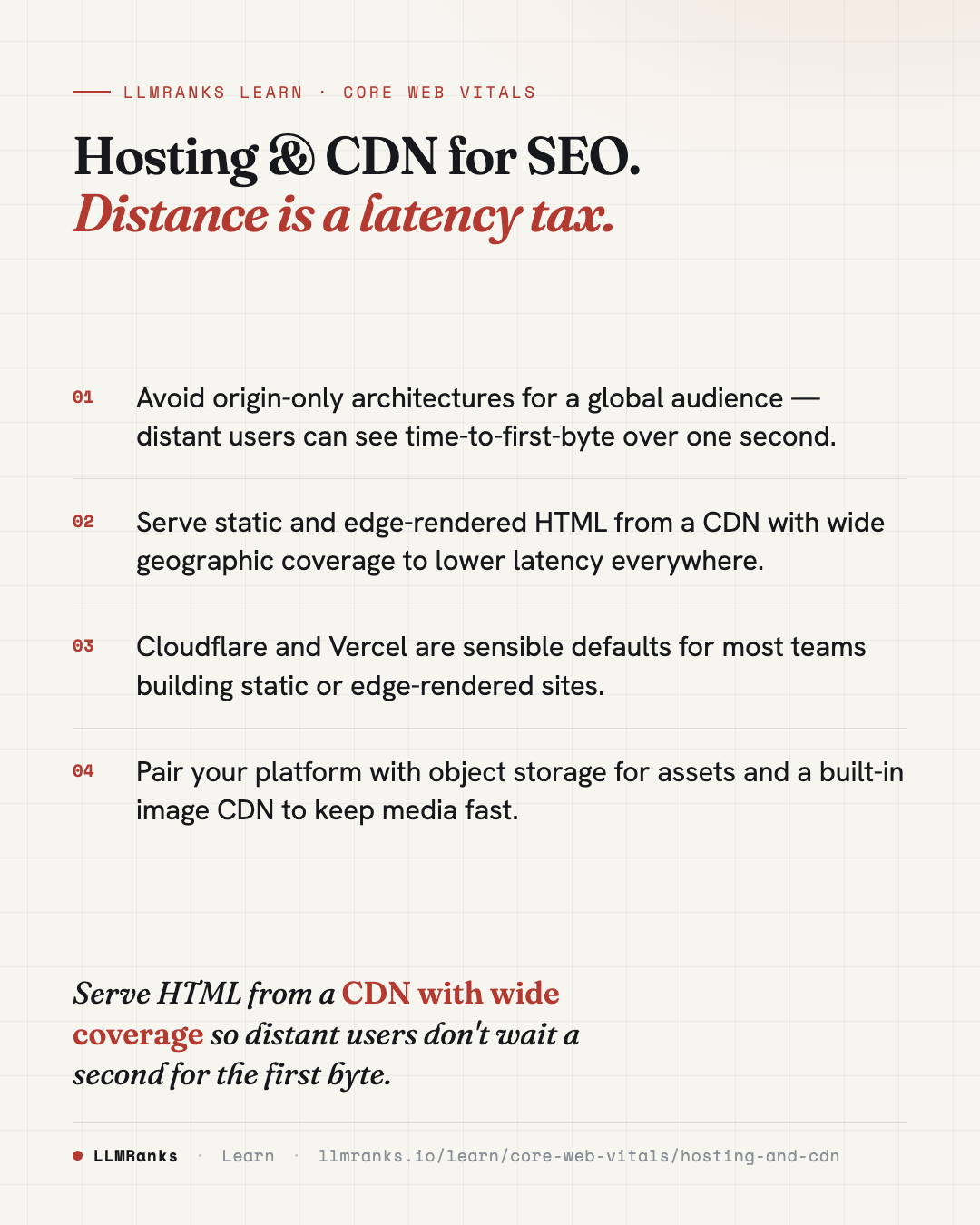
For most teams, Cloudflare or Vercel are the sensible defaults when you're building static or edge-rendered pages. Both serve HTML from the edge, which keeps time-to-first-byte low for users regardless of their location.
For assets, pair your platform with dedicated object storage — Cloudflare R2 or Vercel Blob — rather than serving large files from a single origin. Each of these platforms also includes an image CDN, so you can compress, resize, and deliver media efficiently without building that layer yourself.
The main architecture to avoid is origin-only delivery for a global audience. Without a CDN in front, users far from your origin will experience TTFB greater than one second, which is a poor starting point for both experience and performance metrics.
Edge rendering versus static and origin
There are three broad ways to answer a request, and they differ in how much distance the response has to travel:
- Origin-only — every request goes back to one server. Simplest to reason about, but slowest for distant users, with TTFB that can exceed a second globally.
- Static at the edge — pre-built files are cached across many locations and served from the nearest one. Fast, but best suited to content that doesn't change per request.
- Edge-rendered HTML — pages are generated at the edge close to the user, combining low latency with dynamic output.
Cloudflare serves edge HTML by default, and Vercel, Netlify, Fastly, and CloudFront all support edge execution in some form. The self-hosted option is the exception here, with no built-in edge HTML.
Images and asset delivery
Media is often the heaviest part of a page, so how you serve it matters for speed. Most of the recommended platforms bundle an image CDN: Vercel has next/image, Cloudflare offers Cloudflare Images and Polish, Netlify includes image handling, and Fastly provides image_optimizer. On CloudFront, image optimization runs via Lambda. A self-hosted stack requires you to build your own.
Beyond images, keep large assets on purpose-built object storage such as Cloudflare R2 or Vercel Blob. This keeps heavy files off your origin and served from infrastructure designed for delivery. Faster media directly supports LCP — Largest Contentful Paint, since the largest element on many pages is an image.
How this connects to broader technical SEO
Hosting and CDN decisions are one layer of a healthy technical SEO foundation. Fast, low-latency delivery supports your Core Web Vitals, including INP — Interaction to Next Paint and CLS — Cumulative Layout Shift. It complements — rather than replaces — work on on-page SEO and content strategy & E-E-A-T. Infrastructure gets your content to the user quickly; the content still has to earn the ranking.
What to do
- Audit your current TTFB for users in your key regions, especially those far from your origin server.
- If you're serving globally from a single origin, move to a CDN with wide geographic coverage before anything else.
- For most static or edge-rendered sites, default to Cloudflare or Vercel and serve HTML from the edge.
- Move large assets to object storage such as Cloudflare R2 or Vercel Blob instead of your origin.
- Turn on your platform's built-in image CDN to compress and resize media automatically.
- Reserve self-hosted, origin-only architectures for very high-scale situations where the operational cost is justified.
- Recheck your Core Web Vitals after the change to confirm the latency improvements show up in real metrics.
save this card
 Download card
1080×1350 · post it anywhere
put it to work
See how ChatGPT, Gemini and Google AI actually talk about your brand.