Branded Search Volume
Branded search volume is the number of searches people run for your brand name or brand-plus-keyword terms, and it stands out as one of the hardest signals…
5 min read · updated 2026-07-27
Branded search volume is the number of searches people run for your brand name or brand-plus-keyword terms, and it stands out as one of the hardest signals to fake. Because it directly reflects how many people already know and want your brand, it correlates with almost every real authority dimension — from direct traffic to return visits. Search engines treat navigational and branded queries as a strong quality signal, which makes growing branded search one of the most durable investments you can make in your off-page presence.
Why branded search is the master signal
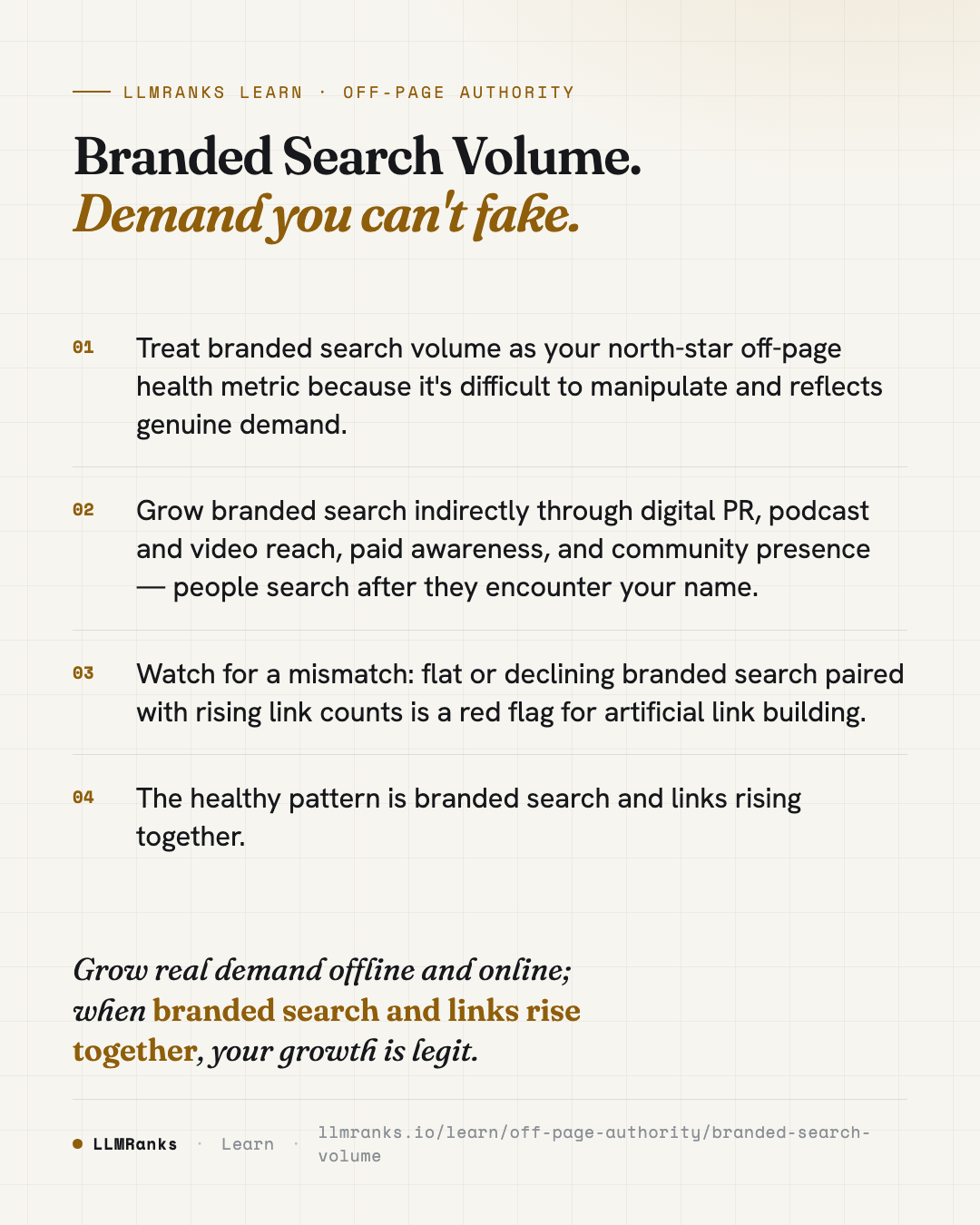
Branded search volume is arguably the single most important off-page signal available, and the reason is simple: it's the hardest to fake. Most authority signals can be gamed cheaply at least for a while, but you can't easily manufacture thousands of real people deciding to type your name into a search box.
That difficulty is exactly what makes it valuable. Branded search is a direct measure of demand and brand recognition. When it rises, it tends to move in step with other genuine indicators of trust — direct traffic, dwell time, and return visits. Search engines have stated that navigational and branded queries act as a strong quality signal, so growing this number does more than look good on a dashboard.
It also does quiet work behind the scenes:
- It legitimizes your link velocity — links look natural when real brand demand is climbing alongside them.
- It feeds entity strength, reinforcing how well search systems understand and trust your brand as a distinct entity.
- It correlates with engagement signals like direct traffic and returning visitors.
For more on how these off-page signals fit together, see Off-Page Authority.
How branded search fits with links and authority
The relationship between branded search and your link profile is where this signal earns its keep as a diagnostic. Links and branded demand should move together. When they don't, the divergence tells you something.
| Pattern | What it suggests |
|---|---|
| Branded search rising, links rising | Healthy, natural growth |
| Branded search flat/declining, links rising | Red flag for artificial link building |
| Branded search rising, links flat | Demand outpacing your visibility work |
A flat or declining branded search trend combined with a rising link count is the pattern to worry about. It suggests links are being acquired faster than real interest in your brand is growing — the fingerprint of link building that isn't backed by genuine demand. The reverse, both rising together, is the pattern you want to see.
This is why branded search is useful even if you never try to grow it directly: it validates the rest of your off-page work. For related context on building links the right way, see Link Tactics: Works vs Avoid and Outreach & Link Velocity.
How to grow branded search
Branded search is downstream of awareness. People search your name after they've encountered it somewhere else, so growth comes from putting your brand in front of the right audiences and letting curiosity do the rest. The main drivers are:
- Digital PR. People see your brand in the news, then search it. Coverage plants the name; the search follows. This overlaps with how unlinked mentions build authority — see Brand Mention SEO.
- Podcast and YouTube reach. People hear your name spoken, then look you up. Audio and video reach convert into branded searches from listeners who want to find you. More on this in Podcasts for Authority & AI.
- Paid brand awareness campaigns. Paid social and display advertising lifts branded organic search — and the lift is measurable in Google Trends. This is one of the clearer cases where paid spend produces a downstream organic effect.
- Community presence. Mentions in places like Reddit and Hacker News drive curiosity searches from people who saw your name in a discussion. See Reddit & Community Signals.
None of these is a direct lever on branded search. They're all ways of increasing the number of people who have a reason to look you up. The common thread is exposure to real audiences in contexts where your brand name registers.
How to audit and track it
Treat branded search volume trend as your north-star off-page health metric. You don't need a complicated setup to monitor it — two sources cover most of what you need:
- Google Trends for the directional shape of interest in your brand name over time.
- Search Console brand-query impressions for how often your brand terms surface in results.
Read them together as a trend, not a single number. The absolute volume matters less than the direction and how it lines up with your other activity. When you're running a PR push, a podcast tour, or a paid awareness campaign, watch for the branded search lift that should follow — that lift is your confirmation the work reached real people.
The most important thing to check is the relationship between branded search and links over the same window. If your link count is climbing but branded search is flat or falling, pause and investigate before that divergence becomes a liability. If both are rising, keep doing what you're doing.
Why it matters for AI search
The same qualities that make branded search valuable for traditional ranking also make it relevant as search shifts toward AI-driven answers. Branded demand feeds entity strength — how clearly systems recognize your brand as a distinct, trusted entity — and entity strength is central to how AI systems decide who to cite. For the connection between off-page authority and AI citations, see Authority → LLM Citations and the broader picture in AEO & GEO.
What to do
- Establish a baseline for your branded search using Google Trends and your Search Console brand-query impressions.
- Set branded search trend as your north-star off-page health metric and review it on a regular cadence.
- Chart branded search against your link count over the same period, and treat any divergence — flat search, rising links — as a warning to investigate.
- Drive awareness through the upstream channels that create branded searches: digital PR, podcasts and video, paid brand campaigns, and community presence.
- After each awareness push, look for the corresponding lift in branded search to confirm it reached real audiences.
- Keep the healthy pattern in view: branded search and links should rise together.
save this card
 Download card
1080×1350 · post it anywhere
put it to work
See how ChatGPT, Gemini and Google AI actually talk about your brand.