Link Tactics: Works vs Avoid
Link building in 2026 still works, but the winning tactics have narrowed sharply. Digital PR, podcast tours, and genuinely useful assets earn editorial…
6 min read · updated 2026-07-24
Link building in 2026 still works, but the winning tactics have narrowed sharply. Digital PR, podcast tours, and genuinely useful assets earn editorial links that also feed your brand into news and training contexts. Meanwhile paid marketplaces, PBNs, and link exchanges carry real penalty risk that outweighs any short-term gain.
What still works
The tactics with positive ROI in 2026 share one trait: the link is a byproduct of something genuinely worth referencing.
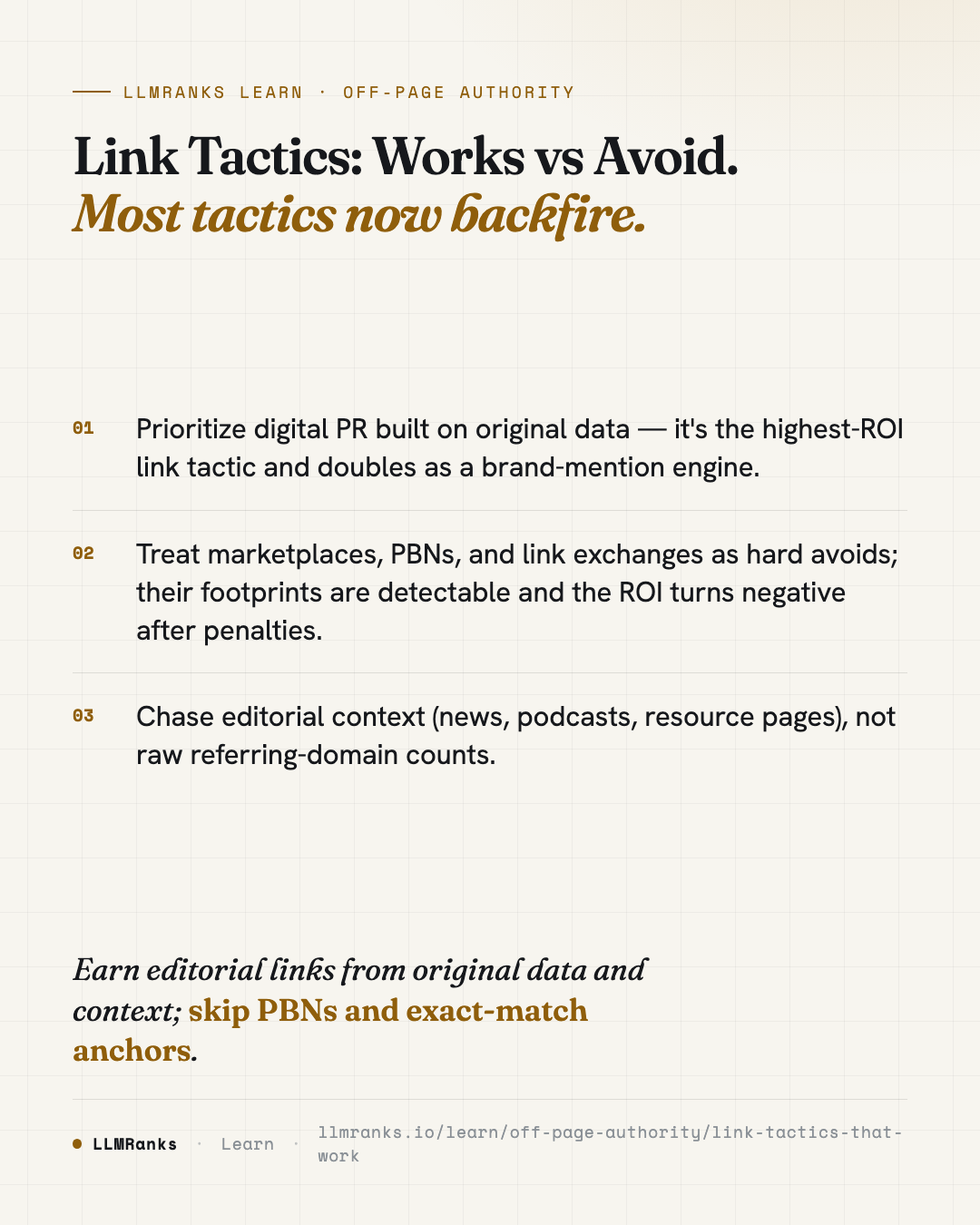
Digital PR is the dominant strategy by a wide margin. The mechanics are consistent: run an original data study (a survey, dataset analysis, or proprietary data release), pitch it to journalists at high-authority publications, and earn 5–50 editorial links with a branded and topical anchor mix. Secondary syndication across outlets like Yahoo, MSN, and AOL drives a long tail. Realistic campaign costs run $8K–$25K, producing roughly 10–40 referring domains, around 60% of them high-authority. The killer benefit is that these links arrive alongside brand mentions in news contexts — a strong signal for Authority → LLM Citations. If your site has zero links from news-eligible domains in the last 12 months, this is where to start.
Podcast tour PR is underrated. A run of 20–40 appearances over six months earns a show-notes link on each (often DR 30–60, but topically precise), and the audio versions get transcribed and indexed. Because podcast transcripts are heavily represented in LLM corpora, this is a massive training signal. Done direct, the cost is time only; booking agencies charge $3–8K/month. See Podcasts for Authority & AI for the deeper playbook.
Guest posts are narrow but alive. They work when the target site has real organic search traffic (>10K/mo), is topically aligned, and doesn't advertise a "write for us" backlink page. Write genuinely good content and use a branded or topical anchor. They're dead on arrival if the site charges fees or hosts a grab-bag portfolio spanning SEO, crypto, CBD, and casinos.
Broken link building still converts at a low 2–5% rate. Scrape competitor backlinks, find linking pages whose target now 404s, and pitch your replacement. It scales poorly but produces clean, contextual links.
Resource page link building remains effective for genuinely useful tools, calculators, and ultimate guides, but it's dying for generic content. Conversion rates have collapsed from roughly 8% in 2020 to 1–2% in 2026 as maintainers get deluged.
Brand-driven tactics compound over time: sponsoring conferences (speaker-bio and event-site links), open-sourcing tools on GitHub (README links and dev-blog mentions), publishing free tools other sites want to reference, and releasing annual "state of the industry" research that gets cited each year. These tie directly into Brand Mention SEO and broader Off-Page Authority.
The HARO successors
The expert-sourcing world changed fast. HARO was sunset by Cision in late 2023 and replaced by Connectively, which itself shut down in December 2024. The market then fragmented:
| Platform | Best for |
|---|---|
| Qwoted | Currently dominant for B2B/PR |
| Featured.com (formerly Terkel) | General expert sourcing |
| Help A B2B Writer | B2B |
| SourceBottle | Consumer/lifestyle |
| ResponseSource | UK |
| X/Twitter #journorequest | Still active, surprisingly effective |
ROI on these platforms has declined as AI-generated pitches flooded them through 2024–2025, and top journalists now filter aggressively. The signal that still cuts through: pitches from named experts with verifiable credentials — a LinkedIn profile plus prior published work — which earn 5–10x the reply rate.
Niche edits: a risk judgment
Niche edits (paying for or negotiating a link inserted into existing ranking content) sit in a gray zone. The risk profile in 2026:
- If the inserted link is contextually perfect, the host page is genuinely authoritative, and no money publicly changed hands, it can be indistinguishable from a natural link.
- If it's purchased through a marketplace, footprint risk kicks in — marketplace-pattern insertions get flagged.
- Host pages often take a slight algorithmic discount after a detected edit. This was a viable 2024-era tactic that has since gotten riskier.
The tell is a paragraph added to an old article whose only substantive change is a new external commercial link — visible by comparing archived versions of the page over time.
What to avoid
These carry footprint risk and, in the worst cases, penalties that make their ROI negative.
Hard avoid:
- PBNs — detection has improved dramatically through hosting-graph, WHOIS-pattern, and content analysis. Even "premium" networks leak footprints, and eventual penalties make ROI negative.
- Paid links on marketplaces — detectable through transaction patterns and host-site footprints.
- Mass link exchanges — direct A→B, B→A swaps are detected, three-way A→B→C→A exchanges have been caught since around 2022, and private N-way Slack-group exchanges are now flagged on footprint analysis too.
- Comment spam, forum profile links, and Web 2.0 properties (Tumblr, Medium spam, Blogspot) — zero value, footprint risk.
- Article and generic web directories — Yahoo Directory was the last one that mattered, and it died in 2014.
- Press release distribution for SEO links — devalued since 2013, still sold to naive buyers.
- GPT-generated guest posts at scale — AI-content and link-spam classifiers compound; a network of AI-content sites linking to you is a strong negative signal.
Use with care:
- Sponsored content — fine when marked
sponsoredand used for brand and traffic, not link equity. - Affiliate links — should be
sponsoredornofollow; don't expect equity. - Reciprocal links — fine in moderation between genuinely related sites, such as partner integrations.
Keep your anchor mix and posting cadence natural across all of these — see Outreach & Link Velocity.
Local citations
For local businesses, citation building is still core, and quality beats volume. A reasonable hierarchy:
- Google Business Profile (the anchor, not strictly a citation)
- Apple Business Connect
- Bing Places
- Industry-specific directories (Avvo for lawyers, Healthgrades for doctors, Houzz for contractors, TripAdvisor for hospitality)
- Major aggregators (Yelp, BBB, Yellow Pages, Foursquare/Factual data layer)
- Local chamber of commerce, local newspapers, and local .gov/.edu mentions
NAP consistency — Name, Address, Phone — matters more than raw count. Even formatting differences like "Suite 100" versus "Ste. 100" create entity disambiguation issues, so keep your strings identical everywhere. Avoid hundreds of low-quality submissions from cheap services; they don't help and create cleanup work later.
What to do
- Check whether your site has earned any links from news-eligible domains in the last 12 months. If not, make digital PR your top priority.
- Build one original data asset — a survey or dataset — and pitch it to relevant journalists with a branded and topical anchor mix.
- Line up a podcast tour (direct or via agency) to earn topically precise links and feed transcript-based training signals.
- Vet every guest-post target for real organic traffic and topical fit; walk away from any site advertising paid backlinks.
- Audit your existing backlinks and disavow PBN, marketplace, exchange, and spam links before they cost you.
- Standardize your NAP string and reconcile it across your top local citations.
- Mark sponsored and affiliate links correctly, and expect no equity from them.
For how these signals connect to AI answer engines, see AEO & GEO and AI Search Engines.
save this card
 Download card
1080×1350 · post it anywhere
put it to work
See how ChatGPT, Gemini and Google AI actually talk about your brand.