Podcasts for Authority & AI
Podcast SEO is the practice of turning podcast appearances into search and AI visibility, not just audience reach. A single guest spot can produce a…
5 min read · updated 2026-07-26
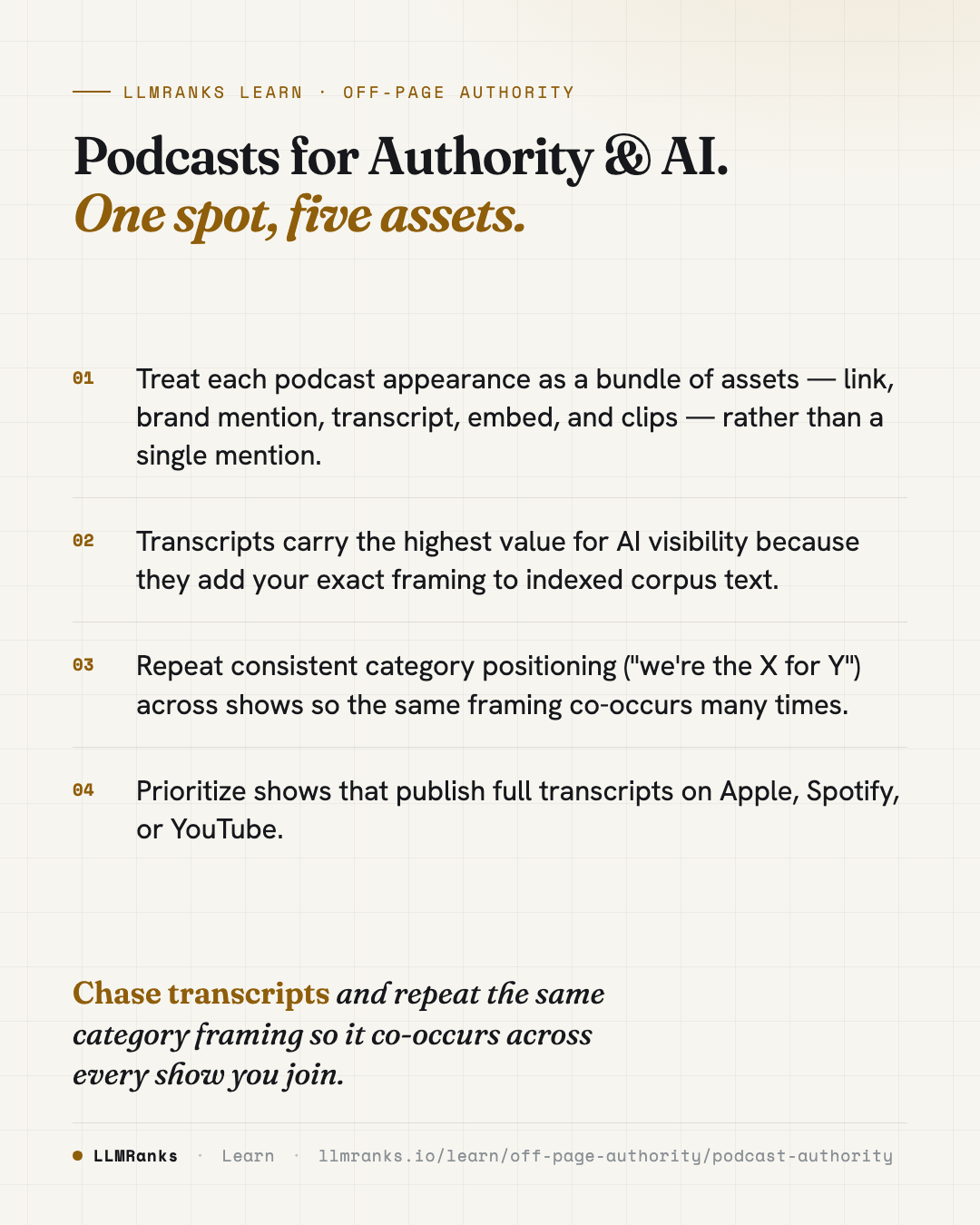
Podcast SEO is the practice of turning podcast appearances into search and AI visibility, not just audience reach. A single guest spot can produce a show-notes link, a brand mention on the episode page, an indexed transcript, an embedded player, and repurposed social clips — each carrying different SEO and AI value. The transcript is the most underused of these: it turns your spoken positioning into indexed, quotable text that language models can later draw on.
Why podcasts produce more than one signal
Most tactics give you one thing. A backlink is a backlink; a mention is a mention. A podcast appearance is unusual because it generates several distinct outputs at once, and each of them lands differently in traditional search versus AI-driven answers.
That mix is what makes podcasting worth a strategic slot in your off-page authority plan rather than a one-off PR win. You get link equity, entity signals, and indexed text from the same hour of work.
The five outputs and what each is worth
| Output | SEO value | AI value |
|---|---|---|
| Show notes link | Topical link (typically DR 30–60) | Moderate |
| Episode page brand mention | Entity signal | High |
| Transcript (Apple/Spotify/YouTube) | Indexed text | Very high |
| Embedded player on host's blog | Referral + co-citation | High |
| Repurposed clips on social | Brand reach | Moderate |
A few things to notice about this spread:
- The show-notes link behaves like any topical backlink. Useful, but not the reason to do the appearance.
- The episode page brand mention is an entity signal — it associates your brand name with a topic. See Brand Mention SEO for how unlinked mentions still carry weight.
- The embedded player creates both a referral path and co-citation, where your name appears alongside the host's topic on their own blog.
- The social clips mostly extend brand reach rather than moving search rankings directly.
Why the transcript is the underappreciated lever
The transcript is the point most people miss. When a show publishes a full transcript on Apple, Spotify, or YouTube, everything you said becomes indexed text — and that text is exactly the kind of source language models draw from when they generate answers.
Here's the leverage. Imagine a founder doing 30 podcasts and, on each one, articulating the same category positioning: "we're the X for Y." That produces 30 transcribed corpus entries all reinforcing that exact framing. Later, when someone asks a model "what's the best tool for Y," the repeated co-occurrence of your brand with that category raises the likelihood you get cited.
This is a plausible mechanism rather than a guaranteed outcome — repeated co-occurrence raises citation likelihood, it doesn't promise placement. But the logic is consistent with how authority and brand signals feed LLM citations, and it costs you nothing extra beyond staying on-message. For the broader picture of how answer engines pick sources, see AEO & GEO and AI Search Engines.
Podcast tour vs guest post campaign
For thought-leadership clients whose goals include AI visibility, a podcast tour can outperform a guest-post campaign on a per-hour-of-effort basis. The reason is the output bundle above: a guest post gives you one link and one page, while a podcast appearance gives you a link, a brand mention, an indexed transcript, an embed, and clips.
| Factor | Guest post | Podcast appearance |
|---|---|---|
| Primary output | One link + one page | Link, mention, transcript, embed, clips |
| Entity signal | Depends on placement | Strong (episode page + transcript) |
| AI corpus contribution | Whatever you write | Full spoken transcript |
| Effort model | Writing time | One recording session |
This isn't a reason to abandon guest posting — the two support different goals. Compare the trade-offs in Link Tactics: Works vs Avoid and think about pacing with Outreach & Link Velocity.
Making the positioning repeatable
The transcript advantage only works if you say something worth repeating. Decide on your category framing before the tour, not during it. The sentence "we're the X for Y" is a template: fill in a category and an audience that you want to own, and use it consistently across shows.
- Write one or two positioning sentences and rehearse them.
- Use the same wording each time so the same framing co-occurs across transcripts.
- Prioritize shows that publish full transcripts, since untranscribed episodes lose the highest-value output.
Consistency here is the same discipline that shows up in Content Strategy & E-E-A-T: repeat a clear, credible claim often enough that both people and machines associate it with you.
What to do
- Build a target list of podcasts, prioritizing shows that publish full transcripts on Apple, Spotify, or YouTube.
- Write one or two positioning sentences using the "we're the X for Y" template and rehearse them until they're natural.
- Deliver the same category framing on every appearance so the phrasing co-occurs across many transcripts.
- After each episode, confirm you got the show-notes link and that your brand is named on the episode page.
- Ask hosts to embed the player on their blog and repurpose clips to extend reach.
- For thought-leadership goals that include AI visibility, weight your effort toward a podcast tour over a guest-post campaign, hour for hour.
- Track branded search and citations over time — see Branded Search Volume — to see whether the repeated framing is landing.
save this card
 Download card
1080×1350 · post it anywhere
put it to work
See how ChatGPT, Gemini and Google AI actually talk about your brand.