Outreach & Link Velocity
Link velocity — the pace at which your site gains backlinks — is not something Google penalizes on its own. What draws scrutiny is an unnatural pattern:…
5 min read · updated 2026-07-26
Link velocity — the pace at which your site gains backlinks — is not something Google penalizes on its own. What draws scrutiny is an unnatural pattern: link acquisition that diverges sharply from your other authority signals like brand search, direct traffic, and engagement. There's no magic safe number of links per week. The reliable approach is to earn links as a byproduct of genuine reach activities, so your link growth and your brand signals move together.
What Google actually says about links
Google's public position — expressed through Search Liaison, ongoing guidance, and the Search Quality Guidelines — is consistent: links should be earned, not built. That distinction matters in practice. Reaching out to inform people about content you've published is acceptable. Reaching out to transact a link — to arrange, buy, or swap it — falls under link schemes.
The cleanest way to check yourself is a single heuristic: would this link exist if search engines didn't? If a link only makes sense as an SEO maneuver, it's the kind Google is designed to discount or act against. If it exists because someone genuinely found your content, product, or research worth referencing, it's the kind that holds up.
This is the same principle that underpins broader Off-Page Authority work: authority accrues from genuine reference, not from mechanical acquisition.
Link velocity: what's really being measured
Link velocity is not penalized per se. Google doesn't punish you for gaining links quickly, and there is no threshold that makes a given rate "safe" or "unsafe." What the system reacts to is unnatural patterns.
The signal that matters is the divergence between link acquisition and your other authority signals. When links pour in but brand search, direct traffic, and engagement stay flat, that gap looks anomalous. When those signals rise together, a fast pace of link growth reads as the natural consequence of real activity.
This reframes the goal. You are not trying to hit a certain number of links per month, or to shape a curve that looks organic. You are trying to do things that genuinely earn attention — and let the links follow.
| If you optimize for... | You tend to produce... | How it reads |
|---|---|---|
| A "natural-looking" velocity curve | Links without matching brand signals | Divergent, anomalous |
| Genuine reach (PR, products, research) | Links plus rising brand search and traffic | Coherent, legitimate |
The 2024-era advice to drop
A common instinct from earlier years was to manage the shape of your link growth — pacing acquisition so the curve looked organic. That advice no longer holds up. Optimizing for the appearance of natural velocity is a workaround; it doesn't address the underlying signal Google uses.
Instead, optimize for earning links as a byproduct of genuine reach activities — public relations, product launches, and original research. These activities naturally produce link patterns that Google reads as legitimate, precisely because the corresponding brand signals move in tandem. The pattern isn't manufactured; it's the real footprint of real reach.
Practically, this connects outreach to the rest of your authority program. Coverage from podcasts, unlinked brand mentions, presence in Reddit and community discussions, and rising branded search volume all move alongside the links you earn — which is exactly why coherent authority looks coherent.
Outreach that stays on the right side of the line
The dividing line is intent. Use these distinctions:
- Inform, don't transact. Telling a journalist, researcher, or site owner about relevant content is legitimate outreach. Negotiating placement, paying, or swapping links is a scheme.
- Anchor outreach to something worth citing. PR moments, product releases, and original research give people a genuine reason to link. That reason is what makes the link survive the "would it exist anyway?" test.
- Let brand signals carry the weight. If your reach activities are working, brand search and direct traffic move too. That coherence is your protection, not a carefully paced link schedule.
For a fuller breakdown of which acquisition methods hold up and which invite risk, see Link Tactics: Works vs Avoid.
Disavow: mostly leave it alone
Guidance on the disavow tool has changed significantly. Google now says most sites should never use disavow. The claim is that spammy links are ignored algorithmically, so routinely disavowing "toxic" links — an obsession from roughly 2018 to 2022 — is discouraged. It can even occasionally remove links that were passing value.
Reserve disavow for two specific situations:
- A manual action notification in Search Console.
- A documented negative-SEO attack with a clear footprint.
Outside those cases, cleaning up links you simply don't like is more likely to hurt than help.
Why this matters for AI search too
The same authority signals that make your link profile coherent also feed how AI systems judge whether your site is worth citing. Genuine reach that produces links and brand signals builds the kind of recognizable authority that carries into AI search engines. If you're thinking about how earned authority translates into being cited by models, the relationship is covered in Authority → LLM Citations.
What to do
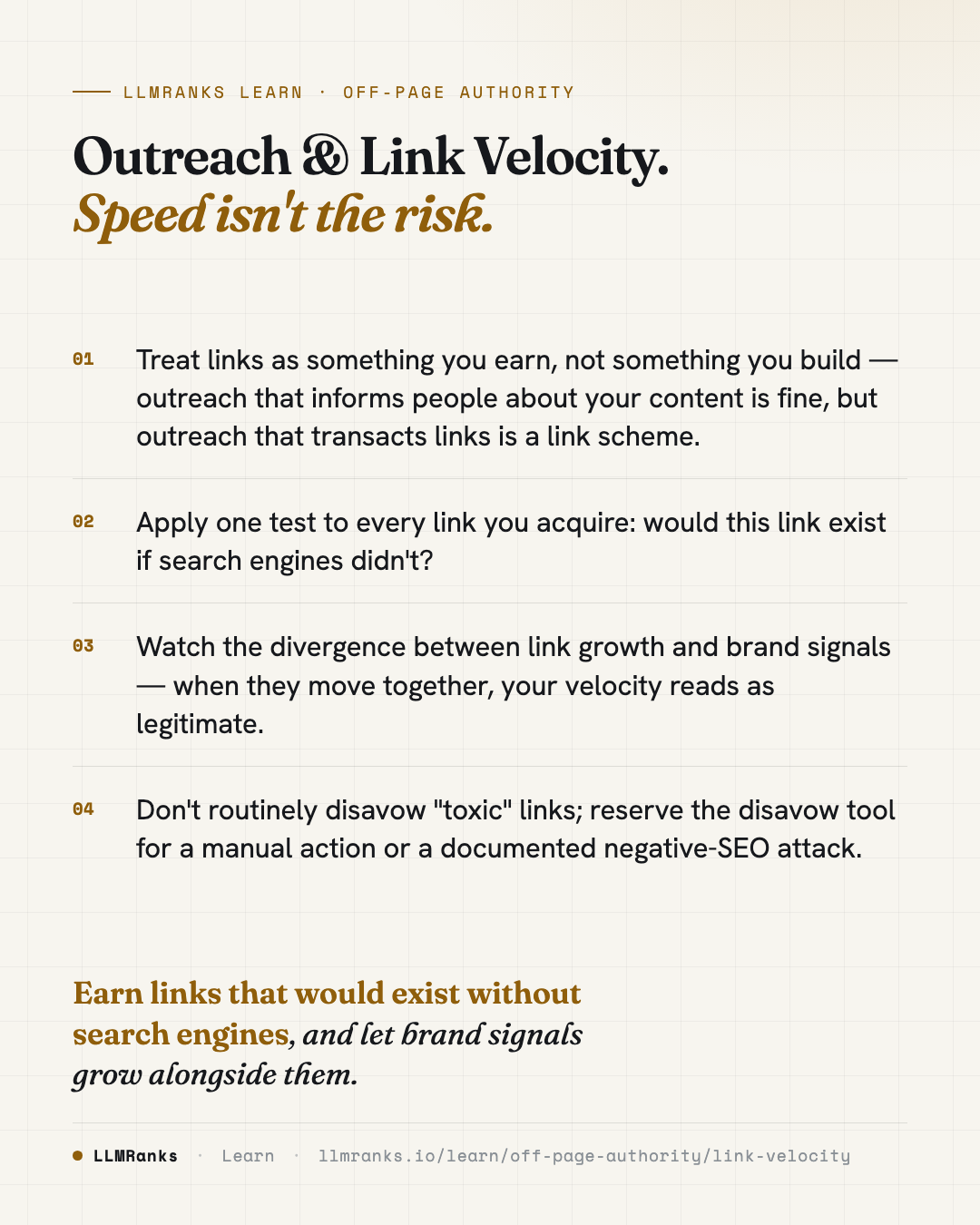
- Apply the "would this link exist if search engines didn't?" test to every link you acquire, and let it govern which outreach you pursue.
- Shift outreach from transacting links to informing people — anchor it to PR moments, product launches, and original research.
- Stop pacing or shaping your link growth to look natural; there is no safe number, and the shape isn't the signal.
- Track link acquisition alongside brand search, direct traffic, and engagement — watch for divergence, and treat coherence between them as the goal.
- Leave the disavow tool alone unless you have a manual action in Search Console or a documented negative-SEO attack with a clear footprint.
- Connect outreach to your wider authority program so links and brand signals rise together rather than in isolation.
save this card
 Download card
1080×1350 · post it anywhere
put it to work
See how ChatGPT, Gemini and Google AI actually talk about your brand.