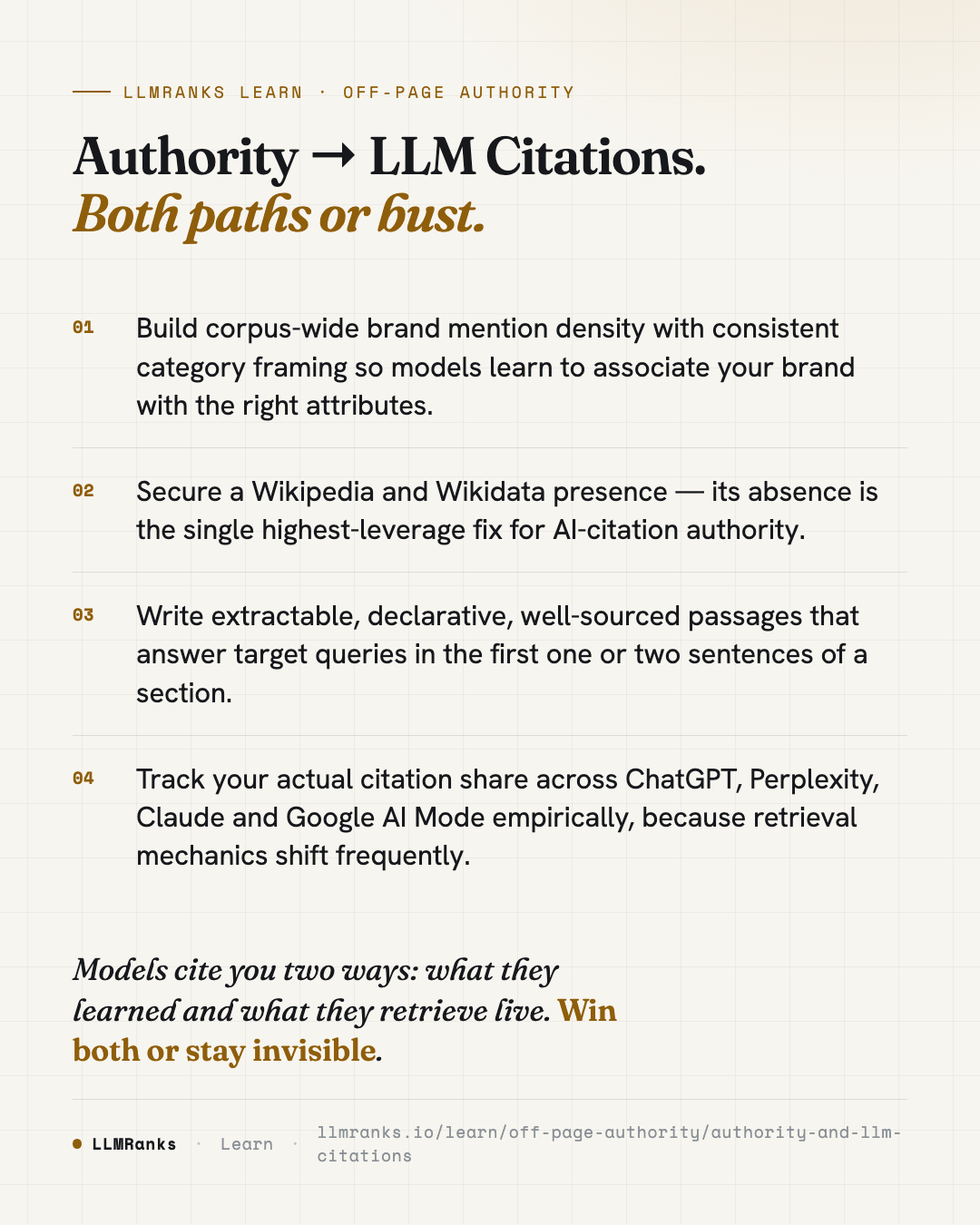
Authority → LLM Citations
Getting cited by AI systems works through two separate pathways, and you need both. First, models can mention your brand from what they learned during…
7 min read · updated 2026-07-27
Getting cited by AI systems works through two separate pathways, and you need both. First, models can mention your brand from what they learned during training (parametric knowledge), which depends on how often and how consistently your brand appears across the web. Second, they can fetch and cite specific pages live at answer time (retrieval), which depends on your authority in the underlying search index plus how extractable your content is. Optimizing for AI citation overlaps with classical SEO but is a distinct target, so treat it separately.
The two pathways to AI citation
AI systems surface your content through two mechanisms, and confusing them wastes effort.
Parametric (training) knowledge is what the model already "knows" from pretraining. It drives whether the model mentions your brand at all when nobody gives it a web link, and whether it associates you with the right category and attributes. This is where brand mentions, co-occurrence, and overall corpus presence matter most.
Retrieval-time citation is what the model fetches and cites live. It drives which specific URLs get linked in an answer, and it depends on the retrieval layer each system uses — Bing's index for ChatGPT and Copilot, Google's index for Gemini and AI Mode, and Perplexity's own index with Bing/Google fallback.
These pull apart in practice. A brand can be in everyone's training data yet never get cited live because its content isn't structured for extraction — or the reverse. Measure each pathway on its own.
How off-page signals map to each pathway
Different authority signals feed the two pathways with very different weight.
| Off-page signal | Parametric (training) impact | Retrieval impact |
|---|---|---|
| High-authority editorial links | Low–moderate | High (drives retrieval ranking) |
| Brand mentions in text (news, blogs) | Very high | Moderate |
| Wikipedia/Wikidata presence | Very high | High |
| Reddit/forum mentions | High | Moderate–high (retrieved live) |
| Podcast/video transcripts | High | Low |
| Branded search volume | Indirect (popularity proxy) | Indirect |
| Structured data / schema | Low | Moderate (aids extraction) |
| Co-citation with category terms | Very high | Moderate |
The pattern: brand-building signals dominate the parametric side, while links and freshness dominate the retrieval side. See Off-Page Authority and Brand Mention SEO for the underlying tactics.
Getting mentioned without a link (parametric)
For unprompted brand mentions, the dominant variable is the frequency and consistency of brand-attribute co-occurrence across the training corpus. A model learns "Notion = collaborative workspace" because that association shows up tens of thousands of times across diverse sources. To raise your parametric citation likelihood:
- Maximize brand mention volume across crawlable, likely-trained-on text: news, Reddit, Wikipedia, high-traffic blogs, GitHub, Stack Overflow, and podcast transcripts.
- Keep your category framing consistent. Describe yourself the same way everywhere so the co-occurrence signal stays coherent instead of diffuse.
- Get into the authoritative sources that carry disproportionate weight. Wikipedia is unusually influential per token because it is clean, structured, and heavily weighted.
Community and audio channels feed this directly — see Reddit & Community Signals and Podcasts for Authority & AI. Branded Search Volume acts as a popularity proxy that correlates with this presence.
Getting retrieved and cited live (RAG)
Retrieval citation looks closer to classical SEO, with some twists.
- Be the highest-authority source for the specific sub-claim the system is answering. Retrieval works on passages, not whole pages, so optimize passage-level extractability: clear claims, statistics with sources, and definitive answers in the first one or two sentences of a section.
- Authority still gates retrieval. Perplexity and Bing-powered systems preferentially retrieve from domains with strong link and brand signals. Your off-page authority decides whether your page even enters the candidate set.
- Freshness matters more here. Recently published or updated authoritative content can get retrieved over stale content, even at somewhat lower authority.
The cleanest way to hold all three in mind:
Off-page authority determines candidate eligibility; passage-level content quality determines selection; brand entity strength determines parametric mention.
Concretely, to enter a retrieval candidate set you generally need classical authority sufficient to rank in the top 10–20 of the underlying index. If you can't rank top-20 organically, you're rarely retrieved. To then be selected and cited, you need extractable, declarative, well-sourced passages — off-page authority doesn't help at this step, but on-page structure does. Work through On-Page SEO, Structured Data & Schema, and Content Strategy & E-E-A-T to build passages that get chosen.
How the major systems differ
The systems behave differently enough that you should probe each one separately. Treat these mechanics as directional and verify them by measuring real citations, because retrieval backends and crawler behavior change often.
- Perplexity — the most aggressive live retriever, typically citing four to eight sources per answer and favoring recent, authoritative content. It runs its own crawler and index with Bing/Google fallback, and is the easiest to influence with strong recent content plus authority. Handle its
Perplexity-UserandPerplexityBotuser agents deliberately in your robots rules. - ChatGPT Search — uses the Bing index plus OpenAI's
OAI-SearchBotandChatGPT-Usercrawlers, so Bing authority matters here, not just Google. Bing has historically weighted exact-match domains, on-page keywords, and social signals more heavily than Google — directional and unverified at current weighting — so audit your Bing rankings on their own. - Claude (with web search) — its retrieval backend isn't officially documented; Brave Search involvement has been publicly reported but may have changed, so confirm empirically. It tends toward fewer, higher-authority citations, favoring strong domain authority and clean factual content.
- Google AI Mode / AI Overviews — runs on the Google index, so your classical Google authority directly governs eligibility, and a passage-selection layer (evolved from featured-snippet logic) decides citation. This is where on-page passage optimization and schema compound with off-page authority.
For a broader map of these platforms, see AI Search Engines and AEO & GEO.
Signals worth tracking
Measure your AI visibility empirically rather than assuming fixed mechanics:
- Direct citation tracking — query ChatGPT search, Perplexity, Claude, and Gemini AI Mode with your target queries, record which domains get cited, and track your citation share against competitors over time. This is now the canonical AI-visibility metric.
- Parametric brand probe — prompt models with something like "What are the leading tools for [category]?" without web access, and check whether you appear. Re-test after major model updates.
- Corpus presence estimate — count brand mentions across the open web, Reddit, GitHub, and major news, and treat Wikipedia presence as a high-weight binary. This proxies your parametric likelihood.
- Wikipedia/Wikidata gap — flag its absence as your highest-leverage fix.
- Citation-eligible content audit — check whether you have passages that directly answer target queries in extractable form, and compare against the competitor passages currently being cited.
What to do
- Check whether you have a Wikipedia and Wikidata presence; if not, prioritize earning one — it's the highest-leverage parametric fix.
- Lock a single, consistent category description of your brand and use it everywhere so co-occurrence signals stay coherent.
- Grow brand mention volume across news, Reddit, GitHub, high-traffic blogs, and podcast transcripts. Use Link Tactics: Works vs Avoid and Outreach & Link Velocity to build authority alongside mentions.
- Confirm you can rank top-20 for target queries in both Google and Bing indexes; if not, close that authority gap first, supported by Technical SEO and Core Web Vitals.
- Rewrite key pages so each section opens with a definitive, well-sourced answer, and reinforce them with Structured Data & Schema and Internal Linking.
- Keep authoritative content fresh, since recency can win retrieval even against higher-authority stale pages.
- Set up ongoing citation tracking across each AI system and review your share against competitors regularly, updating your assumptions as retrieval mechanics change.
For where this fits in the bigger picture, see SEO in 2026 and The Agentic Web, or start from LLMRanks Learn.
save this card
 Download card
1080×1350 · post it anywhere
put it to work
See how ChatGPT, Gemini and Google AI actually talk about your brand.