Brand Mention SEO
Brand mention SEO is the practice of building your brand as a recognized entity across the web so both search engines and AI systems associate your name…
6 min read · updated 2026-07-25
Brand mention SEO is the practice of building your brand as a recognized entity across the web so both search engines and AI systems associate your name with your topic. The big shift from 2024 into 2026 is that unlinked brand mentions now function as a first-class ranking signal — possibly more valuable per mention than a nofollow link from a comparable source. Because the language models that increasingly mediate search read text rather than link graphs, how often and where your brand is named in plain text has become central to visibility.
Why unlinked mentions matter more now
For years, links were the dominant off-page signal. That is changing. One large study of 75,000 brands published in June 2026 measured branded web mentions at a Spearman correlation of 0.664 with AI Overview brand visibility — the strongest of 11 factors tested, and roughly three times the correlation of backlink count at 0.218.
The mechanism is straightforward once you see it. LLMs that sit between users and answers only see text; they do not traverse a link graph the way traditional crawlers do. Entity extraction from raw text has become the new equivalent of PageRank for AI systems. When your brand name co-occurs with a concept enough times — the source example is "Stripe" appearing near "payments infrastructure" tens of thousands of times — that pattern builds a durable association that drives both Google's entity layer and LLM retrieval.
Google has carried implicit entity signals since the Knowledge Graph launched in 2012. What is new in the 2024–2026 window is that plain-text mentions, even without a hyperlink, now feed directly into how these systems decide what your brand is known for. That framing is still an evolving area, and the correlation figures above describe association, not a guaranteed cause — but the direction is clear enough to act on.
How to build brand entity strength
Building entity strength means making it unambiguous to machines who you are and what you do. These sources reinforce each other, so treat them as a stack rather than a checklist you complete once.
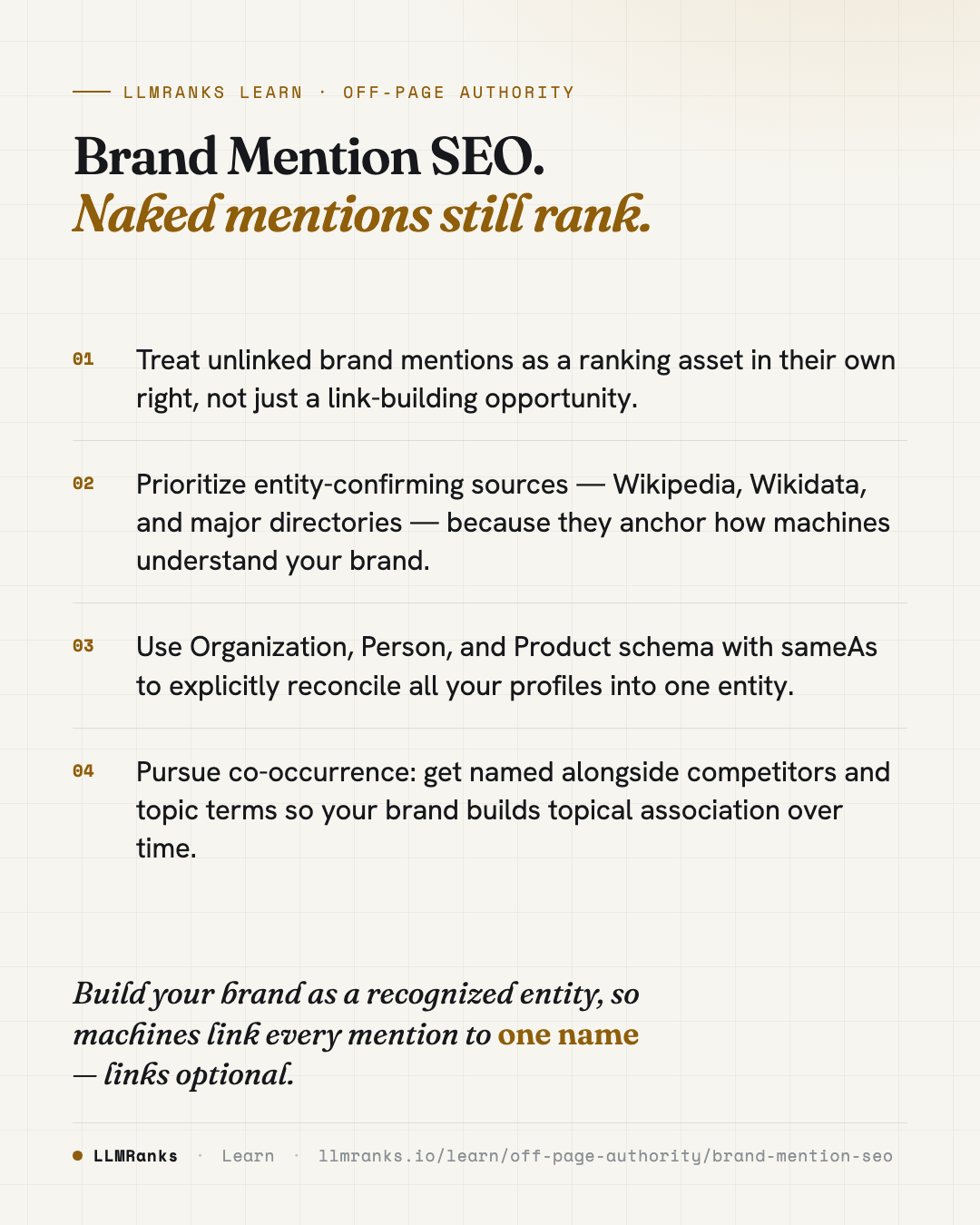
- Wikipedia presence is the single biggest entity signal. Either earn a page — which requires genuine notability and independent sources — or make sure your founders and products are mentioned in related pages where they naturally belong.
- Wikidata entry is easier to obtain than a Wikipedia page and feeds the Knowledge Graph directly.
- Directory and platform profiles on Crunchbase, G2, Capterra, Product Hunt, and GitHub act as entity-confirming sources that corroborate your existence and category.
- Schema markup using
Organization,Person, andProduct, withsameAspointing to every profile you maintain, is the explicit entity reconciliation signal. It tells search engines that all these scattered references are the same entity. See Structured Data & Schema for implementation detail. - Consistent founder and exec presence through bylines, podcast appearances, and conference talks matters because persons function as entities too, and they feed back into your organization's entity. Podcasts for Authority & AI and Content Strategy & E-E-A-T go deeper here.
- Co-citation — being mentioned alongside competitors in "best of" articles, even without a link — builds topical association and signals that you belong in the category conversation.
The through-line is consistency. A brand named the same way, described the same way, and linked via sameAs across dozens of sources is far easier for a machine to resolve into a single confident entity than one scattered across inconsistent references.
The role of co-occurrence
Co-occurrence is the quiet engine behind entity association. Every time your brand name appears near the words that describe your category, you reinforce the connection in both Google's entity understanding and the text that LLMs learn from and retrieve.
This is why "best of" roundups and comparison articles are valuable even when they do not link to you. Sharing space with named competitors places your brand inside the cluster of terms that define your market. Over enough mentions, the association becomes something these systems treat as a known fact about your brand rather than a one-off reference.
To learn how this connects to citations in AI answers, see Authority → LLM Citations and AEO & GEO.
Auditing for unlinked mentions
You cannot improve what you are not tracking. Start by finding where your brand is already being named without a link, then score and act on each mention.
A practical way to surface unlinked mentions is a search query in the form "brand name" -site:brand.com, which returns pages that reference you but excludes your own domain. Monitoring services and web-mention explorers can automate this at scale; simple alerts tend to be weak on their own.
For each unlinked mention, work through three steps:
- Score the source authority. Not every mention is worth chasing; a mention on a strong, relevant site is worth more than many on thin sites.
- Decide whether to request a link. Sometimes an unlinked mention is more valuable left alone as a neutral, third-party citation than converted into a link that reads as solicited.
- Reach out where it makes sense. For high-authority sources, polite outreach to add a link converts at roughly 30%.
| Source type | Primary value | Typical action |
|---|---|---|
| Wikipedia / Wikidata | Core entity anchor | Earn or correct entries |
| Directories (G2, Crunchbase, etc.) | Entity confirmation | Claim and complete profiles |
| "Best of" roundups | Co-occurrence / topical association | Keep the mention; link optional |
| High-authority editorial | Authority + potential link | Consider polite outreach |
For the outreach side of this work, see Outreach & Link Velocity and Link Tactics: Works vs Avoid. Community mentions are covered in Reddit & Community Signals, and the demand side in Branded Search Volume.
Where this fits in your wider strategy
Brand mention SEO sits inside Off-Page Authority, but it now reaches into technical and content work too. Your schema (part of Technical SEO) makes mentions machine-readable, your On-Page SEO and Content Strategy & E-E-A-T generate the reasons people mention you, and the way AI Search Engines read text determines who wins the citation. For the broader trajectory, see SEO in 2026.
What to do
- Query
"brand name" -site:brand.comand build a list of existing unlinked mentions. - Score each mention by source authority and relevance before deciding on any action.
- Secure a Wikidata entry, then work toward a Wikipedia presence if you meet notability.
- Claim and complete profiles on Crunchbase, G2, Capterra, Product Hunt, and GitHub.
- Add
Organization,Person, andProductschema withsameAslinking every profile. - Build consistent founder and exec presence through bylines, podcasts, and talks.
- Target co-citation in "best of" and comparison articles to strengthen topical association.
- Run polite outreach on high-authority unlinked mentions, expecting roughly a 30% conversion.
save this card
 Download card
1080×1350 · post it anywhere
put it to work
See how ChatGPT, Gemini and Google AI actually talk about your brand.