Entity-Based SEO
Entity-based SEO is the practice of getting search engines and AI systems to recognize your brand, people, and products as distinct, well-defined entities —…
5 min read · updated 2026-07-22
Entity-based SEO is the practice of getting search engines and AI systems to recognize your brand, people, and products as distinct, well-defined entities — not just strings of keywords. Search has shifted from matching text to matching entities and the relationships between them, so in 2026 the unit of ranking is the entity-relationship, not the keyword. To compete, you establish a clear identity for each important entity and reinforce it with consistent signals across your own site and third-party sources.
What "entity-based" actually means
An entity is a distinct thing search engines can identify and reason about — a company, a person, a product, a place — rather than a keyword phrase. The move toward entities has been building for over a decade: Hummingbird introduced it in 2013, BERT deepened language understanding in 2019, MUM extended it in 2021, and grounded ranking arrived in 2024–2025.
The practical consequence is that ranking now hinges on how well-defined your entities are and how clearly they connect to related concepts. A page that keyword-stuffs a phrase can still lose to a page whose underlying entities are recognized and trusted. This is why entity work now sits alongside On-Page SEO and Content Strategy & E-E-A-T as table stakes rather than an advanced tactic.
Establish entity identity on your site
The foundation is making each important entity unambiguous. For your company, products, authors, and locations, that means three things working together.
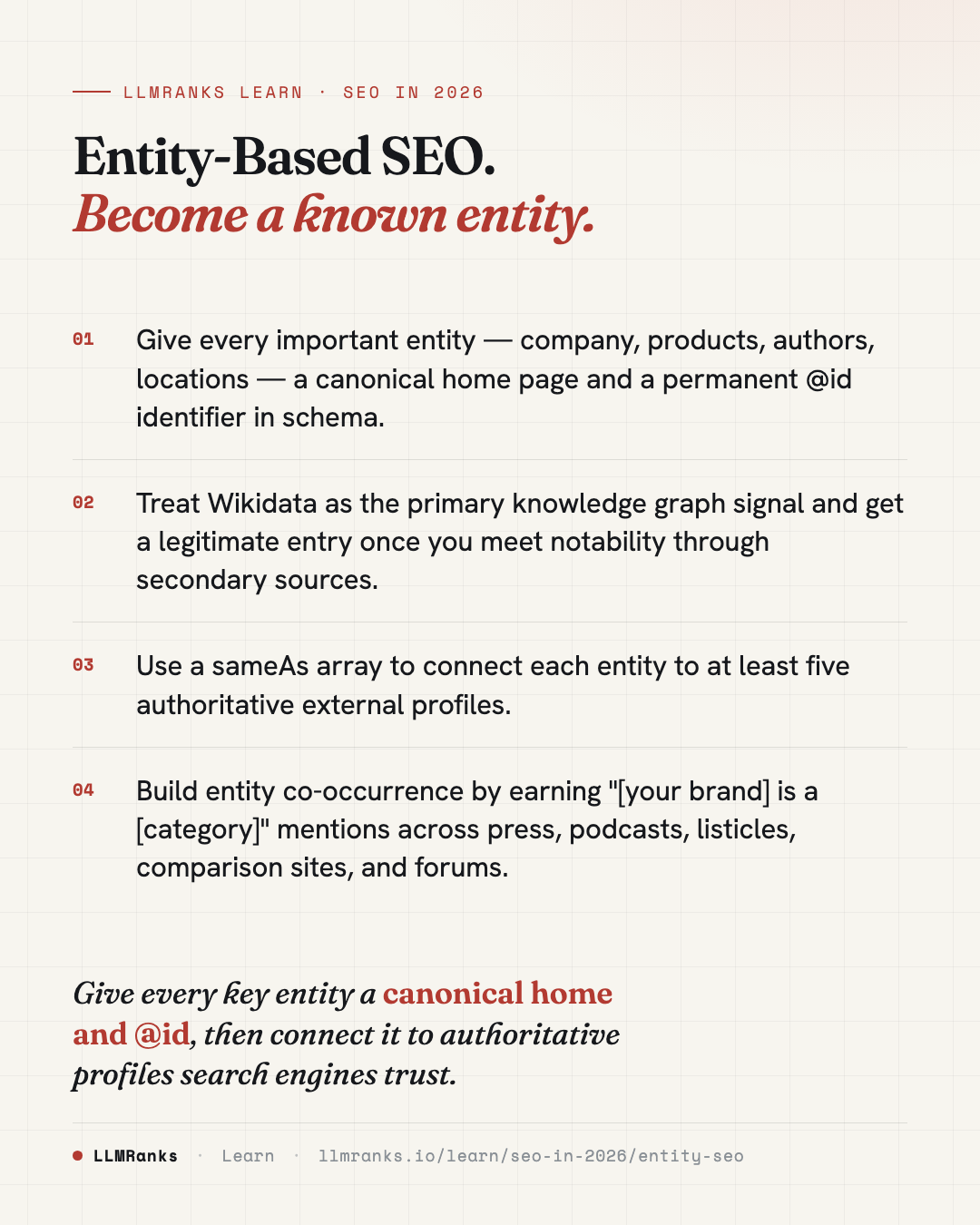
- A canonical URL that acts as the entity's home page — the one address that represents it.
- Schema appropriate to the entity type (
Organization,Person,Product) that carries a permanent@ididentifier, such ashttps://example.com/#organization. - Cross-references to that same
@idfrom every other page, so your whole site points back to a single definition of the entity.
The @id is what ties everything together. When every page references the same identifier, you're telling search systems that these mentions are all about the same thing, not coincidentally similar strings. For the mechanics of implementing this markup, see Structured Data & Schema.
Connect to external references with sameAs
Establishing identity internally isn't enough — you also have to link your entity to how the rest of the web knows it. The sameAs array does this by pointing your schema at authoritative external profiles.
Aim to connect each entity to at least five profiles. Useful targets include:
| Source type | Examples |
|---|---|
| Knowledge graphs | Wikipedia, Wikidata |
| Professional / business | LinkedIn, Crunchbase |
| Developer / social | GitHub, X/Twitter, official social accounts |
| Industry-specific | G2, Capterra for SaaS |
Wikidata is the most important of these. Its Q-numbers feed Google's Knowledge Graph, Bing's, and most LLM grounding pipelines — which is why it functions as the primary knowledge graph signal in 2026. If your brand isn't on Wikidata, work toward getting it on, but do it legitimately: meet notability through secondary sources first rather than creating an entry that won't survive scrutiny.
Build entity co-occurrence off-site
Your own markup declares who you are; third-party sources decide whether that claim sticks. For an association like "[your brand] is a [category]" to be believed, the pattern has to appear repeatedly across independent sources.
That means the same framing showing up in press coverage, podcasts, listicles, comparison sites, and Reddit threads. No single mention makes the connection — it's the consistency across many sources that trains search systems and AI models to treat the association as fact. This is where entity work overlaps with Off-Page Authority: the goal is not just links, but consistent, quotable statements about what your entity is.
Reinforce entities with internal linking
Internal signals matter too. Use consistent entity anchors in your internal links so the same entity is referenced the same way across your site. Inconsistent or vague anchors dilute the connection; repeated, specific anchors strengthen it. See Internal Linking for how to structure this at scale.
Why this matters for AI search
Because Wikidata and the broader knowledge graph feed most LLM grounding pipelines, entity work directly affects whether AI systems can cite and describe you accurately. A well-defined entity with a clean external footprint is easier for these systems to recognize and represent, which connects entity-based SEO to AEO & GEO and visibility in AI Search Engines. If your entity is ambiguous or thinly referenced, both traditional search and AI answers are more likely to get you wrong.
What to do
Work through this audit for your most important entities — start with your organization, then your products and authors.
- Add
Organizationschema with a permanent@idon every page, and reference that same@idsitewide. - Populate a
sameAsarray pointing to at least five authoritative external profiles. - Confirm a Wikidata entry exists with structured claims — and if it doesn't, pursue one legitimately once you meet notability through secondary sources.
- Check that a Knowledge Panel appears when you search your brand name.
- Review your brand SERP for "[brand]" and make sure you own the top five-plus results and that they're clean.
- Mark up content authors as entities with
Personschema and their ownsameAslinks. - Mark up products with
Productschema, includingoffersandreviews. - Standardize your internal linking so it uses consistent entity anchors.
- Pursue third-party mentions that repeat your "[brand] is a [category]" framing across press, podcasts, listicles, comparison sites, and forums.
save this card
 Download card
1080×1350 · post it anywhere
put it to work
See how ChatGPT, Gemini and Google AI actually talk about your brand.