Microsoft Copilot & Bing Chat
Microsoft Copilot (the rebrand of Bing Chat) answers queries using Bing's search index, augmented with live fetches, and routes between OpenAI and…
5 min read · updated 2026-07-19
Microsoft Copilot (the rebrand of Bing Chat) answers queries using Bing's search index, augmented with live fetches, and routes between OpenAI and Microsoft's own MAI models in a way that isn't publicly documented. The most important thing to understand is that being present and healthy in the Bing index is the gate for Copilot citations — the same way Google's index gates AI Overviews. Many sites with strong Google visibility underperform in Copilot simply because they neglect Bing. If you want Copilot to cite your site, Bing index health and freshness are where you start.
How Copilot retrieves and cites
Copilot runs on Bing's search index with retrieval that is Bing-index-first, then augmented with live fetches. There is no separate "Copilot bot" — the crawler is Bingbot, the same crawler used for classic Bing search. Microsoft's AI-specific controls are managed through Bing Webmaster Tools, the noindex/nosnippet directives, and the relatively underused NOAI meta tags.
A minimal robots directive to allow the crawler looks like this:
User-agent: bingbot
Allow: /
Copilot displays numbered superscript citations with a source list, plus inline "Learn more" links. In the Edge sidebar version of Copilot, citations link directly, and the page you're currently viewing is itself treated as a source. This page-context retrieval is a Copilot-specific behavior — the content on the screen can feed the answer, not just indexed pages.
Why the Bing index is the gate
Being in the Bing index is the gate for Copilot citations. If you're not indexed by Bing, you can't be cited, regardless of how well you rank on Google. This matters more than most teams expect: Bing's index is shallower than Google's and its ranking differs, so content that performs well on Google can be effectively invisible on Bing.
Common reasons sites underperform in Copilot despite strong Google presence:
- No Bing Webmaster Tools verification
- No sitemap submitted to Bing
- No IndexNow integration, so index freshness lags
- Content flagged with
nosnippet - Thin or poorly structured pages
Copilot's source selection correlates strongly with Bing organic ranking — top Bing results dominate Copilot citations, and that link is much tighter than Google AI Overviews' loosened relationship to ranking. Reputable, well-structured sources are favored, and different Copilot surfaces (Edge, Windows, Microsoft 365) may surface different source mixes depending on context.
IndexNow: the highest-leverage lever
Microsoft's IndexNow protocol lets you push URL change notifications directly to Bing. It's the single highest-leverage and most-ignored Copilot tactic, and it has also been adopted by Yandex and others.
How it works in practice:
- Submit URLs on publish or update via the IndexNow API.
- Bing recrawls near-instantly, keeping Copilot's index fresh.
- Some CDNs, including Cloudflare and Akamai, offer automatic IndexNow integration.
For news and time-sensitive content, IndexNow is the difference between a same-hour Copilot citation and a multi-day lag. This is the fastest freshness lever available across the AI engines covered on this site.
What gets cited, what gets ignored
Copilot favors content that already ranks in Bing organic and that carries clear structure and authority. Wikipedia, major news, and official sources see the same authority bias you'll find on other engines, and Microsoft-ecosystem-relevant content tends to surface for enterprise and productivity queries.
| Tends to get cited | Tends to get ignored |
|---|---|
| Pages ranking well in Bing organic | Pages not in Bing's index |
FAQPage, QAPage, HowTo, Article schema | Content ranking on Google but invisible on Bing |
| Content with clear answer structure | nosnippet-flagged content |
| Authoritative domains with backlink profiles | Poorly structured or thin content |
| Wikipedia, major news, official sources |
Clean structured data matters because Bing uses Schema.org JSON-LD for rich captions and Copilot answers. Pairing that with clear answer structure — the same discipline that helps with AEO & GEO — gives Copilot something clean to lift.
Bing's ranking quirks
Bing has historically weighted certain signals more heavily than Google, and this carries into Copilot. Treat the following as directional — Bing's exact current weighting is unverified, and MAI integration is narrowing the gap in 2026.
- Lexical over semantic. Bing's algorithm remains less semantic and more lexical in 2026. Exact-match anchor text and domain signals carry more weight than they do on Google.
- Social signals. Bing has long weighted social shares more than Google, and this influence appears to persist in Copilot.
- On-page keywords. Bing has historically weighted exact-match domains and on-page keywords more heavily.
This means solid on-page SEO and off-page authority work pays off in ways that are slightly different from your Google playbook — the fundamentals overlap, but Bing rewards more literal keyword and anchor signals.
The Microsoft ecosystem angle
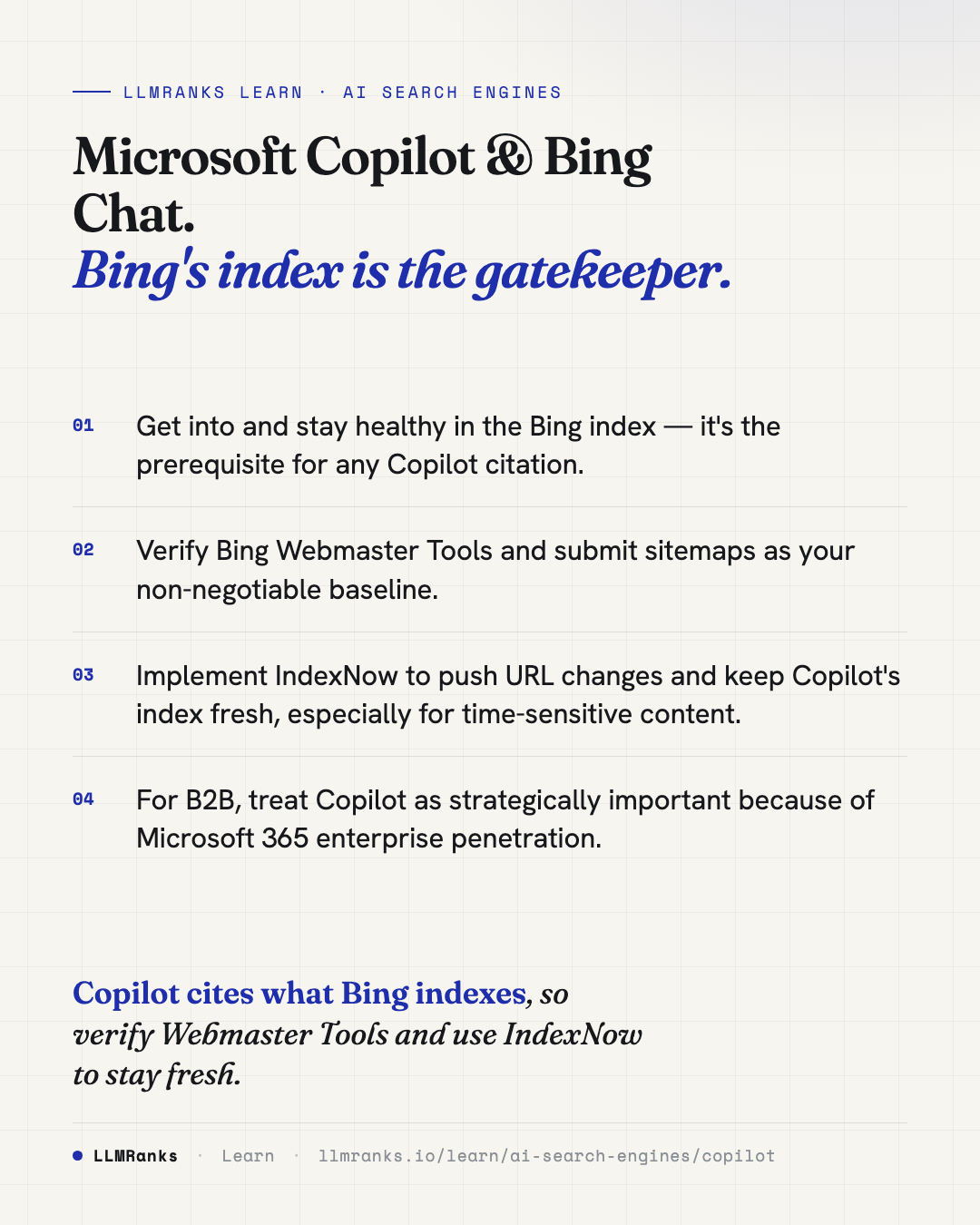
Copilot is not one product but several surfaces: web, Edge, Windows, Microsoft 365, and the mobile app. Its overall market share remains modest compared with ChatGPT and Google AI, but enterprise penetration through Microsoft 365 makes it strategically important for B2B content.
For B2B and enterprise work, presence in the contexts Copilot pulls from matters. LinkedIn, which Microsoft owns, feeds some Copilot enterprise answers, so authoritative presence there can influence enterprise-oriented responses.
How Copilot has changed
- 2024: The Bing Chat → Copilot rebrand was mid-completion, and the product was heavily dependent on GPT-4-class models.
- 2026: Copilot spans multiple surfaces, has partially migrated to Microsoft's own MAI models, offers deeper page-context retrieval in Edge, and benefits from wider IndexNow support. The routing between OpenAI and in-house models is opaque.
If you're planning coverage across engines, Copilot slots into a broader cross-engine AI visibility approach alongside ChatGPT Search, Perplexity, and Gemini and AI Overviews.
What to do
- Verify your site in Bing Webmaster Tools and submit your sitemaps — this is the non-negotiable baseline.
- Check that your key pages are actually in the Bing index, not just Google's; Bing's index is shallower and its ranking differs.
- Implement IndexNow so URL changes reach Bing near-instantly — use your CDN's automatic integration if it offers one.
- Add clean Schema.org JSON-LD (
FAQPage,QAPage,HowTo,Article) so Copilot has structured content to cite. - Strengthen Bing-specific ranking signals: exact-match anchor text, on-page keywords, and social shares.
- Remove or review
nosnippetflags on pages you want cited. - For B2B, build authoritative presence in Microsoft-ecosystem contexts, including LinkedIn, to influence enterprise Copilot answers.
- Prioritize IndexNow submission for news and time-sensitive pages to win same-hour citations.
save this card
 Download card
1080×1350 · post it anywhere
put it to work
See how ChatGPT, Gemini and Google AI actually talk about your brand.