Gemini, AI Overviews & AI Mode
Google AI Overviews are AI-generated answer blocks that appear above traditional search results for roughly 30–50% of queries, powered by Gemini and drawing…
7 min read · updated 2026-07-19
Google AI Overviews are AI-generated answer blocks that appear above traditional search results for roughly 30–50% of queries, powered by Gemini and drawing from Google's standard search index. They are one of three distinct Google AI surfaces — alongside AI Mode (a full conversational experience) and the standalone Gemini app — each with different mechanics. Being indexed and snippet-eligible is the only technical requirement to be eligible for citation; no special markup or extra files are needed.
Three distinct Google AI surfaces
Google now runs three separate AI experiences, and treating them as one leads to bad decisions:
- AI Overviews (AIO): Answer blocks above traditional results, triggered for roughly 30–50% of queries (varies by vertical). Powered by Gemini, sourced from the standard Google index.
- AI Mode: A full conversational mode, rolled out broadly through 2025. It uses query fan-out, turning a single query into multiple sub-queries that each retrieve sources, then synthesizes one answer.
- Gemini app / API: A standalone product with web grounding via Google Search, behaving more like ChatGPT Search.
For a broader view of how these fit alongside other engines, see AI Search Engines and Cross-Engine AI Visibility.
Crawlers and the opt-out myth
Googlebot continues to crawl for the main index. Google-Extended is the consent token for Gemini training and grounding. The critical point: blocking Google-Extended does not remove you from AI Overviews or AI Mode citations if you're in the regular index. This is by design and remains controversial — AI Overviews use the same index as classic Search.
User-agent: Googlebot
Allow: /

User-agent: Google-Extended
Allow: /          # Allow Gemini training/API grounding
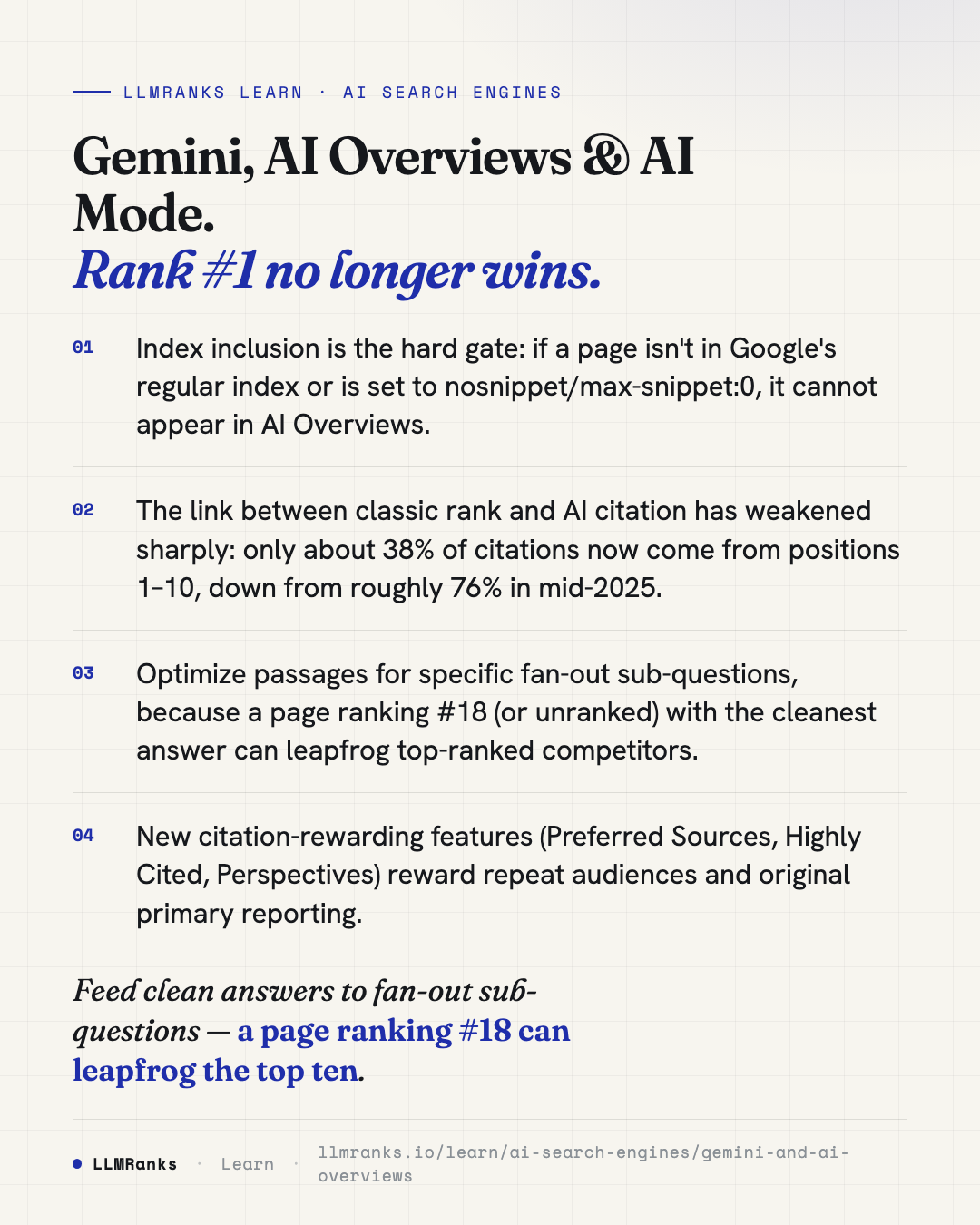
To opt out of AI Overviews specifically, the only effective option is nosnippet or max-snippet:0 — but that also kills your regular SERP snippets. There is no clean opt-out from AI Overviews without sacrificing classic SEO, and this stayed unchanged through the EU regulatory pressure of 2024–25.
The 2024-era advice to "block Google-Extended to stay out of AI" is flatly wrong today: it costs you Gemini API grounding citations while doing nothing for AIO or AI Mode.
When AI Overviews trigger
Trigger probability increases for informational, multi-faceted queries — "how to", "what is", "best way to", "compare X vs Y" — and for queries where multiple agreeing sources give Google high confidence in synthesizing an answer.
They are suppressed for:
- YMYL topics (medical, financial, legal) — partial suppression remains
- Navigational queries
- Very high-stakes or controversial queries, where thresholds tightened after 2024 hallucination embarrassments
- Some regulated jurisdictions (the EU applies different trigger thresholds)
How fan-out changed the ranking game
The link between classic rank and AI citation has weakened sharply. A study of 863K keyword SERPs and 4M cited AIO URLs (Ahrefs, early 2026) measured:
| Citation source | Share |
|---|---|
| Positions 1–10 | ~38% (down from ~76% in July 2025) |
| Positions 11–100 | ~31% |
| Beyond top 100 | ~31% (passages that uniquely answer a fan-out sub-query) |
Google officially documents that both AI Overviews and AI Mode use query fan-out — "issuing multiple related searches across subtopics and data sources." The only eligibility requirement is being indexed and snippet-eligible; no extra files, schema, or markup. Note that "fan-out" is the industry's label, and Google publishes no sub-query count. The only credibly measured figure — roughly 10.7 sub-queries on average — comes from practitioner testing (Seer Interactive, Nov 2025), not from Google.
The practical takeaway: passage-level optimization for fan-out sub-questions beats head-term rank. A page ranking #18, or not ranking at all, can leapfrog top-ranked competitors when it holds the cleanest answer to a specific sub-question.
Two-stage fan-out
Fan-out is often two-stage (verified via a robot-vacuum probe, June 2026). The model issues an initial broad or authority search, reads which entities the trusted sources currently rank, then fires a second wave of specific entity-verification sub-queries.
Critically, the specific products or brands in the fan-out come from live retrieval, not the model's memory. In testing, the engine searched for product models that postdate its own training cutoff, and the named entities shuffled run to run — a fixed prior would stay stable. What the prior does supply is a stable retrieval strategy: which sources to trust, plus a current-year modifier.
The consequence for AEO & GEO: an engine's shortlist mirrors what the trusted review sources rank right now, discovered live — not what the model remembers. To enter that shortlist, you must be cited or ranked in those first-wave sources, not merely covered on your own page.
AI Mode and topical clustering
Consider the query "best CRM for B2B SaaS with HubSpot integration." AI Mode may break it into sub-queries like "best CRM for B2B SaaS," "CRM HubSpot integration," "B2B SaaS CRM features," "CRM pricing comparison," and "[specific CRM names] reviews." Each retrieves its own source set, and the final answer synthesizes across all of them.
This changes what to optimize:
- A page that comprehensively covers one sub-topic gets pulled in for its sub-query, even if it doesn't rank for the head query.
- Coverage breadth on a single page matters less than being the definitive answer to a specific sub-question.
- You can win AI Mode citations for queries you'd never rank for in classic search by owning a narrow sub-intent.
This makes topical clustering more powerful than ever: a cluster of focused pages, each owning one sub-intent, collectively dominates fan-out retrieval better than one monolithic page. Support it with strong Internal Linking and a deliberate Content Strategy & E-E-A-T approach.
Citation-rewarding features (May 2026)
Three features shipped on May 27, 2026 that change the publisher game:
- Preferred Sources: Users pick sources to prioritize; those links get labeled in AI results and see roughly 2× click-through. Building a repeat audience — newsletter, community, returning readers — now has a direct AI-search payoff.
- Perspectives carousel: Timely articles plus forum and social viewpoints surface inside AI responses for developing topics.
- Highly Cited labels: Expanded to more web links, flagging the primary reporting that other articles reference. Original research and primary data now carry an explicit product reward.
What Google AI favors and ignores
Favored:
- Content already ranking in classic Search — index inclusion is the gate.
- Strong passage-level relevance to specific sub-intents.
- Fresh content for Query Deserves Freshness topics.
- Content matching Google's E-E-A-T framework: demonstrated experience, author expertise, site authority, and trust signals.
On structured data: valid markup for still-supported rich-result types (Product, Review, Recipe, Dataset) supports classic rankings and rich results, but it is not a direct AIO citation lever. Controlled testing found no citation lift, and Google states no special markup is needed for AI features. FAQ and HowTo rich results have been retired. See Structured Data & Schema for what still applies.
Ignored:
- Non-indexed pages (the hard gate).
max-snippet:0/nosnippetpages, excluded from AIO snippets.- Pages failing Core Web Vitals badly enough to suppress ranking (LCP > 4s, INP > 500ms, or CLS > 0.25; good thresholds are LCP ≤ 2.5s, INP ≤ 200ms, CLS ≤ 0.1).
- Thin or duplicate content.
- Content flagged by the helpful-content systems, now fully integrated into core ranking rather than a separate update.
What to do
- Confirm index inclusion first. Make sure target pages are indexed and snippet-eligible; nothing else matters until this is true. Review Technical SEO if pages aren't getting crawled or indexed.
- Leave
Google-Extendedallowed unless you specifically want to forgo Gemini API grounding — it does not control AIO or AI Mode. - Map content to likely fan-out sub-queries. Build FAQ sections and sub-headings that answer specific sub-intents, and use On-Page SEO to make each passage a clean, self-contained answer.
- Build topical clusters of focused pages, each owning one sub-intent, rather than one monolithic page.
- Win featured snippets, since those sources are reused heavily in AIO — the correlation persists into 2026.
- Strengthen entity signals with clear
OrganizationandPersonschema plussameAslinks to improve Knowledge Graph recognition. - Maintain rich-result eligibility for still-supported types to aid classic CTR and rankings, which gate AIO retrieval — without expecting the markup itself to lift citations.
- Cultivate Preferred Sources status by building repeat audiences and brand recall, and back it with Off-Page Authority.
- Publish original data — surveys, benchmarks, and proprietary datasets — to earn Highly Cited labels and the downstream citations they bring.
save this card
 Download card
1080×1350 · post it anywhere
put it to work
See how ChatGPT, Gemini and Google AI actually talk about your brand.