Cross-Engine AI Visibility
A cross-engine AI visibility strategy means optimizing so that ChatGPT, Claude, Perplexity, Google's AI surfaces, and Copilot can all find, fetch, and cite…
6 min read · updated 2026-07-20
A cross-engine AI visibility strategy means optimizing so that ChatGPT, Claude, Perplexity, Google's AI surfaces, and Copilot can all find, fetch, and cite your content. The single biggest lever is not schema markup — it's making sure the right crawlers are allowed and that your answer text lives in fast, server-rendered HTML. Beyond that, a small set of content patterns earns citations across every engine, while a few tactics only matter on specific platforms.
Start with crawler permissions
The most common visibility failure isn't weak content — it's accidentally blocking the crawlers that feed AI answers. Different bots serve different functions, and conflating them leads teams to block citation-earning crawlers while thinking they're only opting out of training.
Crawler reads
- HTML markup
- Plain text
- Outbound links
Agent drives
- Clicks & navigates
- Fills out forms
- Compares & checks policies
| Agent | Engine | Function | Blocking effect |
|---|---|---|---|
OAI-SearchBot | ChatGPT | Search index/crawl | Removes from ChatGPT search |
ChatGPT-User | ChatGPT | Live fetch (user-initiated) | robots.txt may not apply — not reliably blockable |
GPTBot | ChatGPT | Training | No citation effect |
OAI-AdsBot | ChatGPT | Ad landing-page safety | No citation effect |
ClaudeBot | Claude | Index | Removes from Claude search |
anthropic-ai | Claude | Training (legacy) | No citation effect |
PerplexityBot | Perplexity | Index | Removes from Perplexity |
Perplexity-User | Perplexity | Live fetch | Blocks live citations |
Googlebot | Index (gates AI Overviews) | Removes from Search + AIO | |
Google-Extended | Gemini training/grounding | No AIO/AI Mode effect | |
bingbot | Copilot | Index (gates Copilot) | Removes from Bing + Copilot |
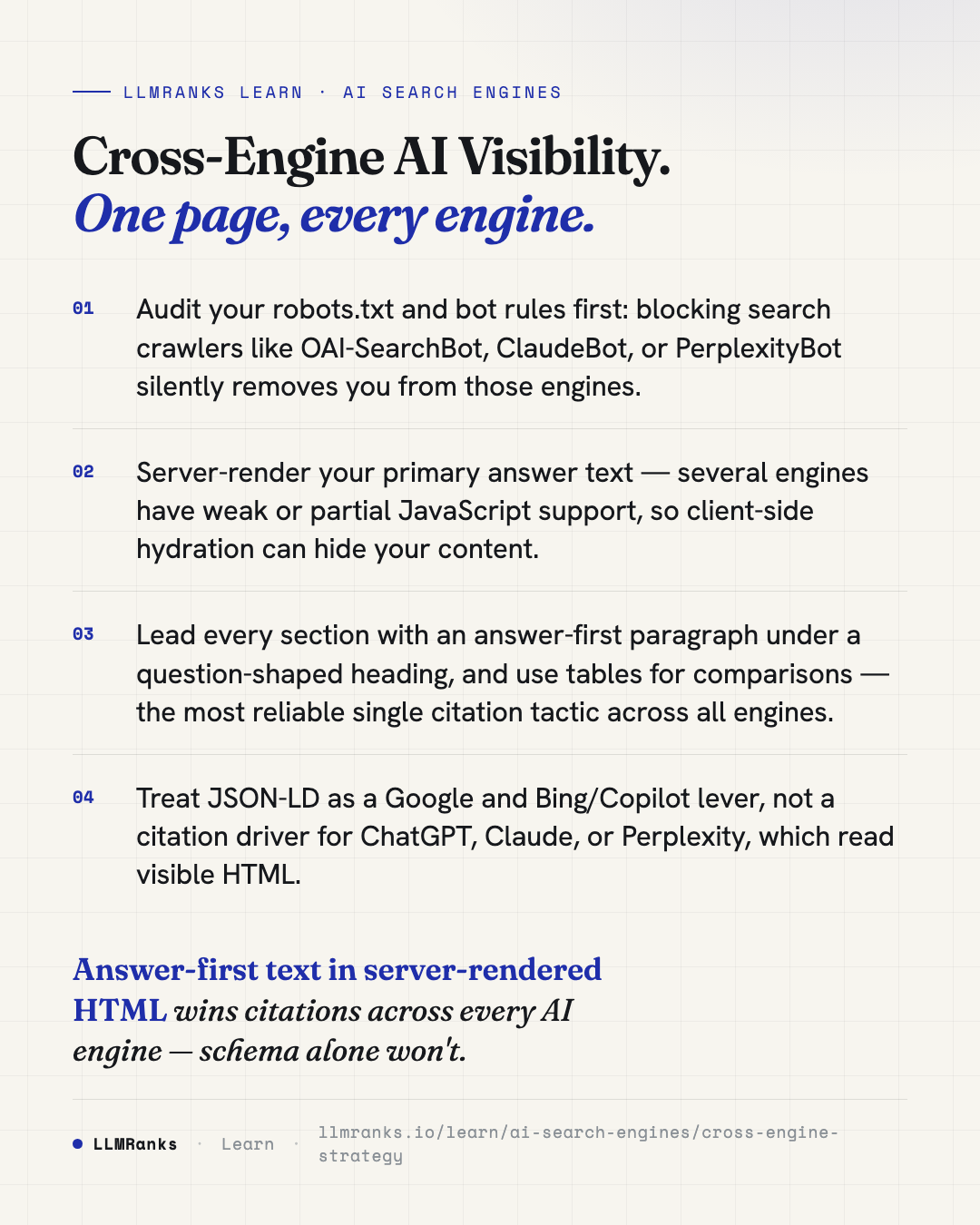
Treat any rule that disallows OAI-SearchBot, ClaudeBot, PerplexityBot, or Perplexity-User as a critical error — unless you have deliberately opted out of AI citation. A blanket User-agent: * Disallow is catastrophic for AI visibility. Note that Anthropic's exact crawler taxonomy is one of the less-confirmed areas for 2026; a dedicated search-fetch agent name for Claude is unverified, so check names against live Anthropic documentation before acting.
For the deeper mechanics of each platform, see How ChatGPT Search Works, How Claude Web Search Works, How Perplexity Ranks Sources, Gemini, AI Overviews & AI Mode, and Microsoft Copilot & Bing Chat.
The content patterns that work everywhere
Some tactics correlate with citation regardless of platform. Prioritize these because they compound across every engine at once.
- Answer-first structure. Put the direct answer in the first one or two sentences after a question-shaped heading. All engines do passage extraction, so lead with the payload.
- Declarative, quotable sentences. Clean declarative claims survive both verbatim quoting and paraphrase.
- Tables for comparisons and specs. These are disproportionately cited everywhere — the most reliable single tactic.
- Original data. Surveys, benchmarks, and proprietary datasets are your only defense against source-diversity rotation. If you're the origin, you can't be substituted.
- Entity grounding.
OrganizationandPersonschema withsameAslinks to Wikidata, LinkedIn, and ORCID improve recognition across all engines; Perplexity and Google lean on it hardest. - Honest freshness signals. Use accurate
datePublishedanddateModifiedvalues backed by real content changes. InflateddateModifiedwithout genuine edits risks trust down-weighting on freshness-sensitive engines. - Fast, server-rendered HTML. Claude's headless rendering is weakest, Perplexity runs tight timeouts, and ChatGPT's search crawler has only partial JS support. Server-render your primary content and never depend on client-side hydration for the answer text.
These patterns sit at the intersection of On-Page SEO, Content Strategy & E-E-A-T, and AEO & GEO.
The JSON-LD reality check
The 2024 over-investment in schema is now partially obsolete for AI citation. Schema still matters — but for narrower reasons than many teams assume.
- Google uses JSON-LD heavily; it gates rich results, which in turn feed AI Overviews. Worth full investment for Google surfaces.
- Bing/Copilot uses it for rich captions and answers. Worth it.
- ChatGPT, Claude, and Perplexity extract from visible HTML and largely ignore JSON-LD for citation. Controlled tests (Ahrefs, 2026) found no measurable citation lift from adding
ArticleorFAQPageschema on those LLM-only surfaces.
The practical rule: implement schema for Google and Bing rich-result eligibility — which indirectly helps AI Overviews and Copilot — but don't expect JSON-LD to drive ChatGPT, Claude, or Perplexity citations. On those platforms, the lift comes from visible content structure: semantic HTML, clean heading hierarchy, answer-first paragraphs, and tables. See Structured Data & Schema for implementation detail.
How the engines differ
Once your fundamentals are solid, tune for each platform's retrieval behavior. The table below summarizes where they diverge.
| Dimension | ChatGPT | Claude | Perplexity | Google AI | Copilot |
|---|---|---|---|---|---|
| Retrieval model | Index + live fetch | Live-fetch heavy | Search-first | Index + fan-out | Bing index + fetch |
| Source diversity | Moderate | Moderate | Forced/high | Fan-out broad | Bing-rank tight |
| Freshness strength | Good | Conservative | Strongest | QDF-dependent | IndexNow-driven |
| JS rendering | Partial | Weakest | Tight timeout | Strong | Moderate |
| JSON-LD use | Low | Low-moderate | Low | High | High |
| Primary-source bias | Moderate | Strongest | Strong | Moderate | Moderate |
| Best lever | Tables + passage structure | Author authority + primary sourcing | Wikidata + originality + Reddit | Sub-intent coverage + rich results | IndexNow + Bing SEO |
| Key 2026 shift | Proprietary index | Native search launch | Publisher deals + Pages | Fan-out + weakened rank link | MAI models + multi-surface |
A few practical reads from this: Perplexity forces high source diversity, so originality and Wikidata grounding matter most there. Google's fan-out rewards broad sub-intent coverage, which ties into Internal Linking and cluster depth. Copilot follows Bing ranking closely, so Bing index coverage and IndexNow are the levers. Treat the Copilot model-routing details as directional rather than precise — Microsoft's routing between OpenAI and its own MAI models is one of the least-confirmed areas for 2026.
Bing index parity is a Copilot blind spot
Because Copilot draws from the Bing index, pages that rank in Google but are missing from Bing are invisible to Copilot. Compare your Google and Bing index coverage, flag the gaps, and use IndexNow to close them. This is a distinct workstream from your Google-focused Technical SEO and worth checking explicitly.
What to do
- Audit
robots.txt, WAF rules, and any AI-bot toggles against the crawler matrix; fix any false blocks onOAI-SearchBot,ClaudeBot,PerplexityBot, orPerplexity-User. - Verify Claude and Perplexity crawler names against live vendor documentation before changing rules, since those taxonomies are less confirmed.
- Measure time-to-first-byte under bot user-agents, remove JS dependency from primary content, and clear interstitials or cookie walls — critical for Claude and Perplexity.
- Rewrite key pages to answer-first structure under question-shaped headings, and add tables wherever you compare things.
- Add
OrganizationandPersonschema with completesameAslinks, and confirm Wikidata presence for your core entities. - Implement JSON-LD for Google and Bing rich-result eligibility, but don't market it as a driver of ChatGPT, Claude, or Perplexity citations.
- Check date fields against real content-change history and remove any inflated
dateModifiedvalues. - Compare Google versus Bing index coverage, fix Copilot blind spots, and integrate IndexNow.
- Map likely fan-out sub-queries for your target topics and confirm your content cluster covers each one.
- Publish original data you own, so you remain a source that can't be substituted.
For related planning, see SEO in 2026, The Agentic Web, and the broader AI Search Engines overview on LLMRanks Learn.
save this card
 Download card
1080×1350 · post it anywhere
put it to work
See how ChatGPT, Gemini and Google AI actually talk about your brand.