Do Core Web Vitals Affect Rankings?
Core Web Vitals are a real ranking signal, but a weak one. Google treats page experience as a tiebreaker between results of similar relevance — content,…
5 min read · updated 2026-08-16
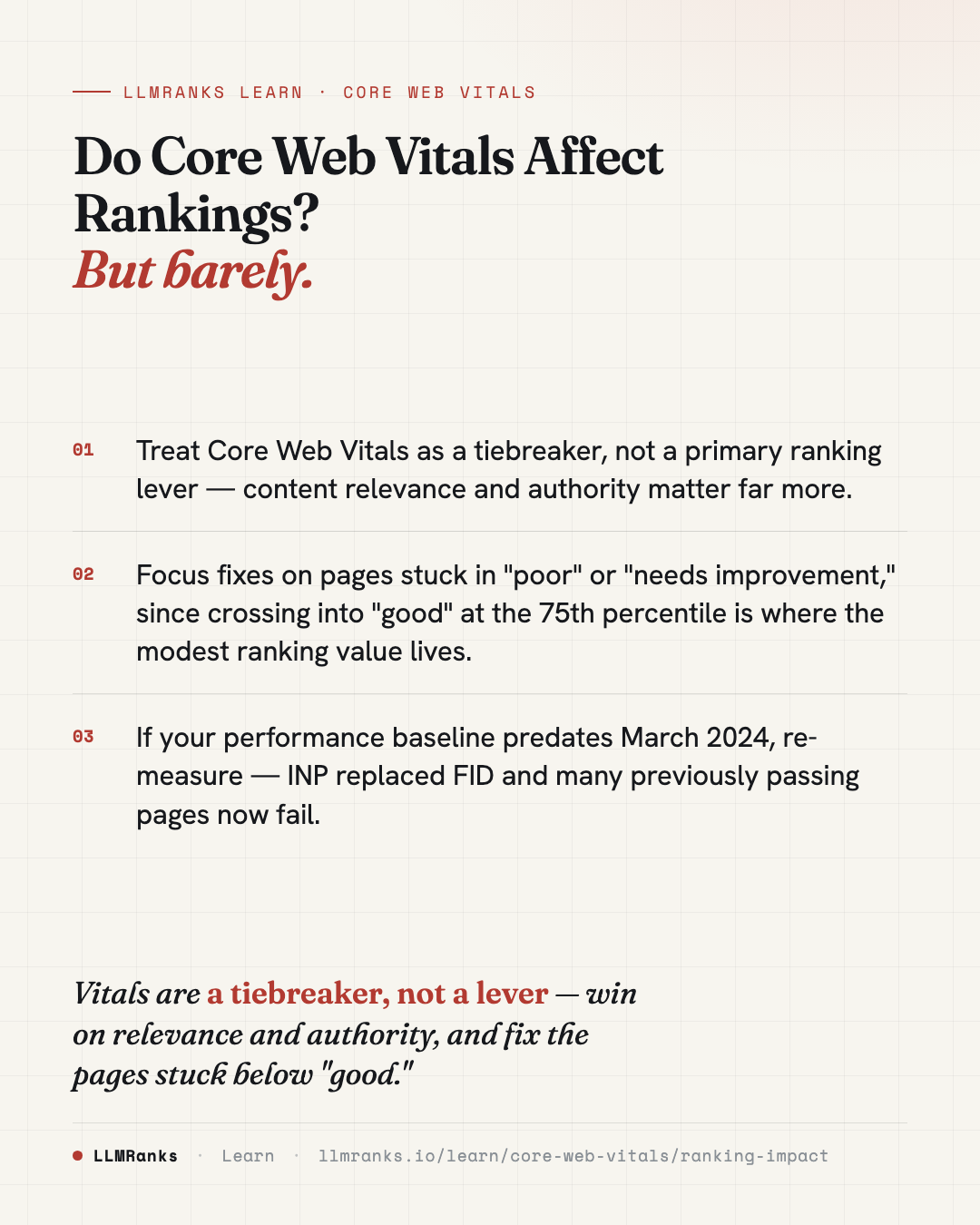
Core Web Vitals are a real ranking signal, but a weak one. Google treats page experience as a tiebreaker between results of similar relevance — content, links, and topical authority do the heavy lifting. The signal is threshold-driven, so the value is in crossing from "poor" or "needs improvement" into "good," not in shaving milliseconds off pages that already pass.
Yes, but it's a weak signal
Core Web Vitals do affect rankings — Google's public position, backed by consistent third-party correlation studies through 2024–2025, is that page experience signals act as a tiebreaker among results of similar relevance. When two pages are roughly equal on the factors that actually decide rankings, the faster, more stable one can edge ahead.
That framing matters. Content relevance, links, and topical authority dominate the ranking equation. If you're competing on a query where your content is thinner or your authority weaker, no amount of performance tuning closes that gap. Core Web Vitals sharpen an already-competitive page; they don't rescue a weak one.
If you're deciding where to invest, weigh Content Strategy & E-E-A-T, Off-Page Authority, and On-Page SEO ahead of chasing perfect vitals scores.
The signal is threshold-driven, not gradient-driven
The relationship between Core Web Vitals and rankings is threshold-driven. You get whatever modest boost exists once a page passes all three metrics at the "good" level, measured at the 75th percentile of real user experience. Beyond that point, further improvement yields essentially no additional ranking benefit.
Concretely: moving LCP from 2.4 seconds to 1.2 seconds does roughly nothing for rankings, because both are already inside "good." The marginal SEO value comes from crossing the line from "poor" or "needs improvement" into "good" — not from micro-optimizing pages that already pass.
This has a direct practical consequence. Sort your pages by their current status and spend your effort on the ones failing a threshold, not the ones already green.
| Page status | Ranking value of further work |
|---|---|
| Poor → Good | Highest — this is where the boost lives |
| Needs improvement → Good | Meaningful — crossing the threshold |
| Good → "faster good" | Negligible for rankings |
The three metrics you're crossing thresholds on are LCP, INP, and CLS. Lab-only signals like TTFB, FCP, and TBT help you diagnose problems but aren't the field metrics used for the threshold — see TTFB, FCP & TBT Lab Metrics for how they fit.
The real payoff is conversion, not rankings
The largest measurable business impact of Core Web Vitals work is conversion and engagement — not rankings. Documented case studies consistently show that improvements lift conversion by 5–20% and reduce bounce.
That reframes how you should justify the work. A faster, more stable page keeps more users on it and moves more of them toward whatever action you care about. Those gains are larger and more reliable than the tiebreaker ranking effect, and they show up regardless of where you sit in the results.
So when you make the case for performance work to a team, lead with revenue and engagement. Rankings are a secondary, softer benefit layered on top.
INP raised the bar in March 2024
INP (Interaction to Next Paint) replaced FID as a Core Web Vitals metric in March 2024, and it raised the bar. FID only measured the delay before the first interaction and ignored everything after it. INP evaluates responsiveness across the whole session, so many sites that comfortably passed under FID now fail under INP.
If your historical performance baseline predates 2024, re-baseline. A page you signed off as "passing" a couple of years ago may no longer qualify, and you won't know until you measure against the current metric.
Interaction responsiveness problems usually trace back to heavy JavaScript execution. That makes Third-Party Script Management one of the highest-leverage places to look, alongside your rendering and server setup covered in Hosting & CDN for SEO.
Where Core Web Vitals meet AI search
Core Web Vitals do not directly affect whether an AI overview or LLM cites your content. Those systems prioritize content that's extractable, well-structured, and authoritative — see AEO & GEO for what actually drives citation selection.
There is, however, an indirect connection worth understanding. TTFB and crawlability affect how reliably AI crawlers — like GPTBot, Google-Extended, PerplexityBot, and ClaudeBot — can fetch and re-fetch your pages. Slow or timing-out origins get crawled less, and less crawling can quietly suppress your inclusion in AI answers.
Treat this as a directional inference, not a documented ranking factor: fast server response plausibly helps your visibility in AI search by keeping your content reliably reachable. It's a reason to care about TTFB beyond the classic search context, not a promise of citations. For the broader picture, see AI Search Engines and SEO in 2026.
What to do
- Segment your pages by status. Separate the "poor" and "needs improvement" pages from those already passing, and concentrate effort on the failing ones.
- Re-baseline against INP if your last measurement predates March 2024, since pages that passed under FID may now fail.
- Fix to cross the threshold, not to chase diminishing returns — stop optimizing once a page is solidly "good" at the 75th percentile.
- Prioritize interaction responsiveness by auditing and trimming heavy or third-party JavaScript.
- Justify the work with conversion and engagement, framing improvements around the documented 5–20% conversion lift and lower bounce rather than rankings alone.
- Check TTFB and crawlability so both traditional and AI crawlers can fetch your content reliably.
- Invest in relevance and authority first. Because Core Web Vitals are only a tiebreaker, direct most of your energy toward content and links before performance micro-tuning.
save this card
 Download card
1080×1350 · post it anywhere
put it to work
See how ChatGPT, Gemini and Google AI actually talk about your brand.